Episode Transcript
[00:00:01] Speaker A: Welcome to series seven of the Life of Letters, a podcast exploring the art history and future of calligraphy, handwriting, signwriting and all things letter related.
I'm your host, Laura Edrilyn, and this season we're following letters into the realm of magic, myths and mystery.
It's a journey from legendary worlds and ancient alphabets to hidden codes and spiritual practice.
As we begin another season, I'm delighted that the Life of Letters is once again kindly sponsored by Speedball Arts, whose commitment to quality tools and creative tradition serves artists all over the world.
Pull up a chair, grab a cuppa and let's dive in.
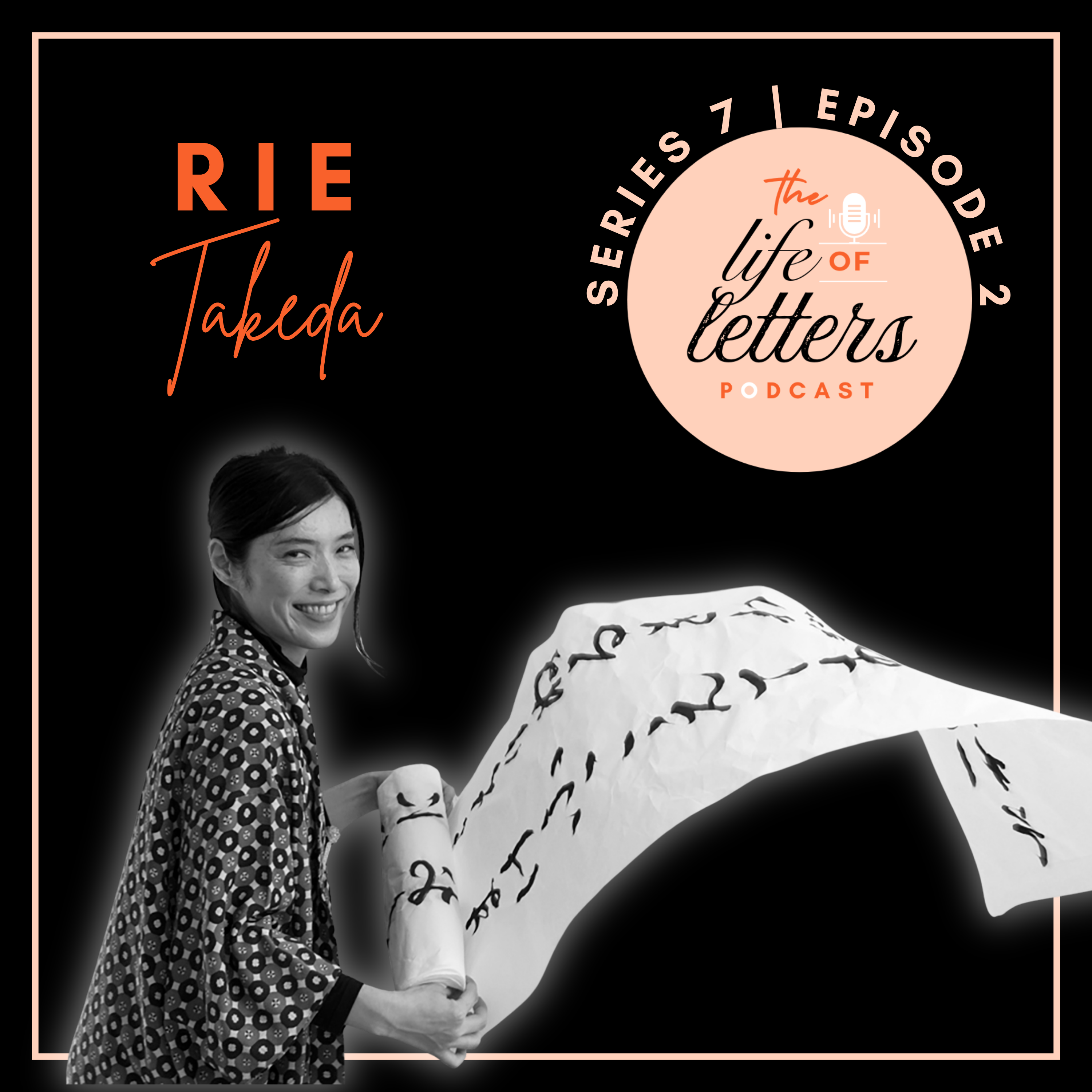
[00:00:45] Speaker B: Today I'm talking to Ria Takeda. Ria is an artist and trained calligrapher who blends traditional craftsmanship with her Neo Japanism style.
Starting at age 5, she has taught mindfulness based shodo globally for more than 20 years, working internationally since 2000. Her accomplishments include an award nominated book, a Domestika course, and design collaborations with Sega and John Lewis.
A huge welcome to the Life of Letters. Rhea. It's lovely to have you here.
[00:01:16] Speaker C: Oh, thank you, Laura. Thank you so much for inviting me to the Life of Letters.
[00:01:26] Speaker B: It's great to have you here. And of course, in this series we are exploring the world of magic and mystery with letters.
And it's really exciting to be talking to you today because I have the feeling that traditional Japanese calligraphy really does capture this.
But for me and any listeners who don't know, know, can you tell us a little bit more about what shodo is?
[00:01:54] Speaker C: Okay, so the shodo is a Japanese word which is often directly translated and described as the way of artistic handwriting or beautiful writing.
I would often say the art of traditional Japanese calligraphy.
And it's got two kanji characters.
Just give you the info.
So the first kanji is sh for shodo, meaning to write or writing.
And the second kanji character is for shoto, meaning the past, the way or the art, and symbolizing the life path we walk or go forward.
And also the shoda is one of the oldest and most profound traditional art forms in Japan, practiced and appreciated since the mid 5th century.
And I find that the deep beauty in shodo is the outcome of diverse techniques and complex brush movements.
And that goes together with the flow of brush and ink.
And the most importantly, it needs to be accompanied by inner stillness, calmness, and the body and mind connection.
Maybe when you see Japanese calligraphers doing the action, you know, this very powerful spiritual sort of feeling you get because of this, you know, like inner stillness and it's easy to say, but trust me, it's not really easy to complete that art form at all.
Yeah, that's the sort of the brief info for Shodo. What shodo is, right? What it is.
[00:04:20] Speaker B: Yeah. Amazing. So there's a quite a practice and an art to it. So I presume it takes people years and years to get to the point where not only are they creating the. The outcome, as you say, that they want, but they're also. It's part of the process.
[00:04:40] Speaker C: Yeah, definitely.
[00:04:43] Speaker B: Can you explain a bit about the tools and the materials that you would use and what's important about them?
[00:04:52] Speaker C: The essential tencels or tools are ink stone, it's called suzuri.
And ink stick is sumi.
And the brush, fude, and paper, it's called kami.
And they are translated as
[00:05:17] Speaker B: well.
[00:05:17] Speaker C: It's called like a bunfo shiho. That means four treasures of the study.
That's the essential four items.
And for calligraphers, we would say the sacred treasures that bridge the calligrapher's inner mind, time and space, and artistic soul to a physical reality on paper.
So those four treasures are the important ones.
And then of course, all the, you know, accessories, the paperweight, the brush holders, water well, desk, pad that comes along. But the four are the important ones.
And each tool or tensils has its ritual artistic importance. As you set up for practice, the most important one is to prepare the ink. I find your own ink. You can create your own ink by rubbing, grinding the ink stick onto the ink stone so the tap water slowly, surely becomes handwrapped, beautiful ink.
And many teachers and classes do not introduce that process properly. Even in Japan, they skip that process.
But I show this process to. To my students in my classes and workshops as an. More like an essential mental preparation stage so they can arrive here and now and, you know, like a switch off our thoughts and routine and calm our nerves down.
And you see, you know, like through preparation, through the rubbing, the ink process, you see the color change, smell the ink scent, and feel the natural texture.
So your senses are opened and activated too. And I find it's very meditative and soothing.
And in my mindfulness method, it's also combined with breathing, so you are grounded and ready for shoto practice.
So tools are not only for the calligraphy, but also for mental warming up.
I find this very important.
[00:08:14] Speaker B: Yeah. Wow.
Wow.
I love that they're called the four treasures as well. I think that just very poetic, right?
Yeah, very poetic. But also it kind of enhances. Enhances The. The sense of what you're doing. You know, when you look at the tools that you're using, if you're thinking of them as treasures, it shifts your mindset from it being something that you're doing on your own to something that you're doing together with the materials together. You know, it's like you're in collaboration, you're working with the treasures and they hold just as much importance as you being the one operating it.
Yeah, yeah. Lovely.
Really lovely. And I can almost picture, as you were talking, I can imagine that the process of making the ink,
[00:09:13] Speaker C: you're almost
[00:09:15] Speaker B: putting in the energy of you. It hasn't been pre prepared and then just given to you. Right. That's the step that is often skipped. Yeah. So you're now part of that process as well. So then when you use the. I guess it's like. I mean, my brain has immediately gone to thinking about making bread or pasta yourself rather than buying it from a shop. Right.
It tastes different because you've done it, you've. You've done the whole process.
Not that I often make pasta or bread myself, but I can imagine that's how it must feel when you're.
Yeah. Grinding the ink and also you're starting somewhere else. I think that's what I maybe don't see in the workshops that I do. You know, you're looking at the tools and you're describing them and it's all very logical and rational and you're sort of thinking about techniques, but that's straight away a kind of cognitive process. Whereas when you're starting with something that you're preparing yourself, you're actually not even in the calligraphy yet. You're not even doing that bit yet. You're kind of making your materials and what you're going to work with. That's really exciting.
So the ink stick, I was just going to ask, where is there something special about the stick?
[00:10:31] Speaker C: Well, it should be organic ink stick is called the sumi and it's.
It's suit with animal glue and aromatic spices.
So, you know, like, it takes a long time to dry and mature. The good ones would take maybe half a year.
You know, it's really, really delicate process and it shouldn't have cracks on it.
And the good one, it gives you very organic aroma, almost like an incense. You know, like a really soothing smell.
Scent.
Yeah.
[00:11:22] Speaker B: That's amazing. And that again, must just enhance the experience of making and doing and connecting to.
Yeah, to you and what you're about to do. There's that There's a sort of space between planning to do something and doing it right.
Beautiful. And you share the magic of Shodo by teaching workshops and courses in London, in Germany and online. But what do you feel is particularly special? What do you see when you're teaching this sort of quite traditional art form to maybe quite modern day people? Is there something that kind of comes out in those workshops that you think this is why I need to teach it?
[00:12:06] Speaker C: There are quite a lot of things I feel very special about, you know, teaching this art in a modern busy life.
But you know, like, since I started teaching the art of Shoto, with my mindfulness method, I can see the students learn not only the artistic technical aspect of Shoto, but also more the meditative mindfulness aspect of Shoto.
So more like discovering their inner self while they are practicing.
And it doesn't matter what kind of age or background or interest or you know, like they come from, they all enjoy experiencing how their body and mind connection or the wholeness, oneness would possibly become visible at once on paper.
I know it sounds very abstract, but you know, this organic process we don't really have in our busy life nowadays.
And you know, because you see every little momentum of your inner state, if you're thinking too much or your dominant wrist or elbow is too stiff, you'd see the shaky lines on paper at once.
And on the contrary, your let go process or your transparent mind or wholeness also can be seen as a light flow on paper, maybe you know as well.
So I find that it's a beautiful way to soothe, self reflect and meditate.
So it's like a meditation emotion.
So the more you do, the lighter you feel with the brush and ink.
And it's a very organic experience in our overloaded digital life. And I believe it helps to deload tension, inner and physical tension, and to be more mindful through the practice of Shoto.
Yeah, that's what I feel and find.
[00:14:54] Speaker B: Yeah, I, I definitely relate to the, the difference in, in lines and the energy that comes out on paper.
[00:15:02] Speaker C: Yeah, you can see that, right?
[00:15:03] Speaker B: You can see it. Absolutely, Absolutely. I think you can also. It's like a little snapshot in time because if you are feeling slightly chaotic or busy or brain fog or anything like that, and you're just trying to, you know, your, your whole body, your.
I'm sure there's sort of biometrics behind it and things, but that your body is sort of tightening in ways that you're not even aware of. So there's a kind of Subconscious conscious story going on that does come out in, in whatever marks you make on paper.
And it's being, yeah. And it's being able to either see that without judgment and which is very hard for a lot of people are also working out how to release it, which I think again, when people get a harder themselves. And I talk a lot with my students about this. The second you're kind of critical about the marks or the strokes that you're doing, your body's going to tighten more. You know, it's being told off. It's being. There's a negativity rather than okay, I see what's happening. I can recognize that it's my body tightening. It's, you know, there's a whole conversation to be had behind it so deep
[00:16:29] Speaker C: and you can't deny it, you know, you see it in front of your eyes, you know, like, and that's, you know, like from positive point of view it's nice because you know, like you got the sense of wholeness or the body and mind connection.
But it's very abstract.
Normally it's just the momentum feeling. Right.
But through the calligraphy, you see it, you know, it's visible in front of your eyes and on paper and that's, I think it's very effective also for kids, you can't deny it because you, you see it, right?
[00:17:16] Speaker B: Yeah. I almost feel like children can work with it even more. They like have, you know, as you get older you start to lose your, your connection with yourself. And whereas children haven't been conditioned quite as much yet with the outcome. So with the calligraphy that you teach, is it, are there particular characters, are there phrases, is a mixture or is it more abstract than kind of specific words or letters?
[00:17:50] Speaker C: It depend on their level.
Often for beginners or for children's class, I bring more pictogram so picture based characters.
That means, let's say the moon or the sun.
It's got the visual background story so they can associate with the character, kanji character and the image of moon. So it's the pictogram.
And I try to bring more seasonal text so they can, you know, like they can be more mindful and they can cooperate this individual, you know, the feeling of the season or the sea or all those natural element while the calligraphy and that's. I find it's very important for shodo. So you put the particular energy while you calligraph a character.
So you calligraph, let's say the character means sea.
You calligraph is the image of the Sea, the color or the sound of waves or smell, you know, all those sense based images together.
So the outcome, I mean the calligraphy would become more alive and individual.
I know it's a bit sound abstract, but that's. I try to sort of bring in my classes and workshops.
[00:19:32] Speaker B: Yeah, no, I, I love that. And you mentioned the word kanji.
Can you explain what that means?
[00:19:40] Speaker C: Kanji is. It's the characters, you know, like can be pictogram or ideogram characters.
[00:19:48] Speaker B: Got you. Okay.
[00:19:49] Speaker C: So they could be story behind, you know, visual story behind.
[00:19:56] Speaker B: Okay, so a Japanese character on its own.
[00:20:01] Speaker C: Yeah. And also they share in Taiwan and Chinese.
So.
[00:20:07] Speaker B: Okay.
[00:20:08] Speaker C: In mainland China they reform this.
I mean the kanji characters. So it's not always identical, but it's, you know, like the character indicates, let's say water element or mountain element, and then becomes different meaning together.
So it's, it's purely picture based characters.
[00:20:35] Speaker B: We're gonna, we're gonna get some visuals and make sure people can see what we're talking about. Yeah, that would be great.
And you have a book as well. So that's another visual kind of resource that people can buy and they can discover more about shodo.
And I wanted to ask you a little bit about the body art projects that you do because these incorporate performance and calligraphy.
[00:21:00] Speaker C: Right.
[00:21:01] Speaker B: Can you tell us more?
[00:21:02] Speaker C: Oh, yes.
This is more like. Well, it's also photography, video combined as a performing art.
And I started this a long time ago in 2001 in London as a performing art and calligraphy in my own poetry on naked human skin.
So the skin was transformed into a three dimensional paper.
So the idea was inspired by the spiritual, magical essence of calligraphy.
I often composed the poem for the story models and each time they would like to express or hear the words.
I design the calligraphy images so they would fit to their body and skin. So I calligraph what they would like to say or express through their own being. And the story models can be an artist, dancer or writer and collaborated with photographers and musicians and videographers.
So it's ongoing project, still sort of developing. And it's always fun to work with. Always different, you know, like creators and artists.
[00:22:40] Speaker B: Yeah. Wow. The connection between all those art forms. Forms as well. And you can kind of see the full circle journey as well. For me, it made me think about the process, particularly with shodo, as you've explained, of creating the inks with our hands. So it starts with our bodies.
The process is made the outcome of the calligraphy and then it's back onto our bodies, which I think is that sort of full circle experience. And I guess these are like installations, right, that people can definitely see. Yeah, yeah.
[00:23:19] Speaker C: And it's. It's like the magic of calligraphy comes from the intention and the energy of the words written by the calligrapher.
So each body art story really inspires me to calligraphy on the body as well as paper, of course.
And when you calligraph with full mind, full energy, the meaning of word would become alive because it's on the, you know, living human skin. And that can really see the transformation. And it's very unique and authentic. I really love that process.
[00:24:00] Speaker B: So you say it's an ongoing project. Are you doing more? How is it kind of coming together, or are you going to exhibit again?
[00:24:08] Speaker C: Always like a new, you know, story model?
It's always different. Story model can be, you know, doesn't have to be artist, but somebody who like to express or say, which they cannot say verbally, maybe, or through the body art project, maybe they can feel their inner pain or trauma.
So it always depend on the story model. But often very intimate.
So I speak with the story model first, what they like to sort of, you know, like express through the words and the poetry.
And then I compose original poem for them, or sometimes they compose the poetry so I can translate into Japanese and then write on their body.
So it's really often like a healing process, I find. So I'm just more like a hairpin, so they can proceed. But often when it's like something really, like, hidden and they like to really heal, I feel very powerful as I calligraph, you know, it's. It's very intimate, powerful process.
Yeah.
[00:25:41] Speaker B: And people can see this or see some of this on your website, right?
[00:25:45] Speaker C: Yeah. So there are some videos, but also there are some photographs.
[00:25:50] Speaker B: Yes.
[00:25:51] Speaker C: Or the series.
[00:25:53] Speaker B: Yeah.
[00:25:54] Speaker C: And you can see often in the Instagram. My Instagram site.
[00:25:59] Speaker B: Is this gonna be a new book?
[00:26:01] Speaker C: You mean Body art?
[00:26:03] Speaker B: Yeah.
[00:26:04] Speaker C: That would be nice, isn't it?
[00:26:05] Speaker B: Yeah. I feel like you've got more than one book in you. You've done the show do body art next.
I think people would love to see it. And yeah, people can definitely have a little look at them online because I think the ones that I've seen are beautiful. And it's great hearing you talk about that process of how you're helping. It's not just a model like that. I love that you call them story models and it's about them and the connection between two humans as well. Right.
I think it's something that's very powerful. And the fact that you're able to help them maybe transition through a trauma or a past pain or something that they need to process as well. Through the magic of calligraphy and an art. I mean, it's just. That is exactly, you know, the sort of powerful side of. Of any art form, but I guess particularly where you can bring words in and poetry.
[00:27:09] Speaker C: Wonderful.
[00:27:11] Speaker B: So this series, we wanted to end episodes with a slightly different question.
Can you tell us what letter of the Alphabet or Japanese character do you feel holds the most magic or mystery and why?
[00:27:29] Speaker C: I was thinking which kanji characters, but I would choose Nen, which means mindfulness in Japanese.
And the kanji character represents the here and now placed directly over the heart, mind and soul.
So the heart of present moment is actually mindfulness in that character. So the character shows that story.
And I believe we can bring mindfulness into our daily activities.
The words we speak, the movements we make, or the actions we choose or intentions we make, we can communicate far more peacefully.
And in doing so, we can be more peaceful ourselves.
That's why I picked this one.
I was thinking maybe love, but I
[00:28:40] Speaker B: think I like this. Yeah. This ties into everything that you've been saying and the, the kind of traditional art and, and why it's so important for shodo to still exist today. You know, the fact that you're, you're bringing it through to new audiences and, and kind of keeping something that's really quite old and traditional and has such a kind of sacred process to it. So the fact that you've picked a word that just epitomizes it is great. Can you say the name of the kanji character? Is it Nen?
[00:29:15] Speaker C: It's called Nen.
[00:29:17] Speaker B: N, E N, N, E, N.
And can you describe. I don't know if this is possible, but can you describe what the character looks like? Can you walk us through the strokes?
[00:29:30] Speaker C: If you envisage, let's say, say two horizontally lay rectangular boxes, the upstairs represents here and now, and the second box underneath is heart, mind and the soul.
So the heart of the present moment equals mindfulness. That's how punchy sort of system works. Yeah. It's not only the boxes.
[00:30:04] Speaker B: Okay. So there's some strokes on the inside.
[00:30:07] Speaker C: Yeah.
[00:30:08] Speaker B: Okay.
[00:30:09] Speaker C: It's just a purely composition wise, you know, there's two rectangular box upstairs you have the character means here and now, and then downstairs you have the heart, mind.
[00:30:27] Speaker B: And so it's beautiful to hear you even talking through it because it kind of helps us create it in our in our mind and imagine creating it ourselves. So yeah, great choice, Nen. I'm gonna look it up and find out more.
But if anybody else wants to find out more about you and all your work, they can visit shodo calligraphy.com or connect with you at Neo Japanism Atelier. And as always, we will put all the links so people can find you in today's show notes. But Rie, thank you so much for joining me today. It's been such a pleasure talking to you.
[00:31:07] Speaker C: Thank you so much. It's been an absolute pleasure.
[00:31:13] Speaker A: Thanks for listening.
Series 7 is made possible by my wonderful producer, Heidi Cullip and the support of Speedball Arts.
If you've enjoyed the episode, don't forget to subscribe, leave a review or share it with a fellow letter lover.
Say hi over on Instagram and watch clips and moments for all the series on YouTube at the Life of Letters podcast. And until next time, keep listening, keep creating and keep celebrating the Life of Letters.