Episode Transcript
[00:00:01] Speaker A: Welcome to series seven of the Life of Letters, a podcast exploring the art history and future of calligraphy, handwriting, signwriting, and all things letter related.
I'm your host, Laura Edrilyn, and this season we're following letters into the realm of magic, myths and mystery.
It's a journey from legendary worlds and ancient alphabets to hidden codes and spiritual practice.
As we begin another season, I'm delighted that the Life of Letters is once again kindly sponsored by Speedball Arts, whose commitment to quality tools and creative tradition serves artists all over the world.
Pull up a chair, grab a cuppa, and let's dive in.
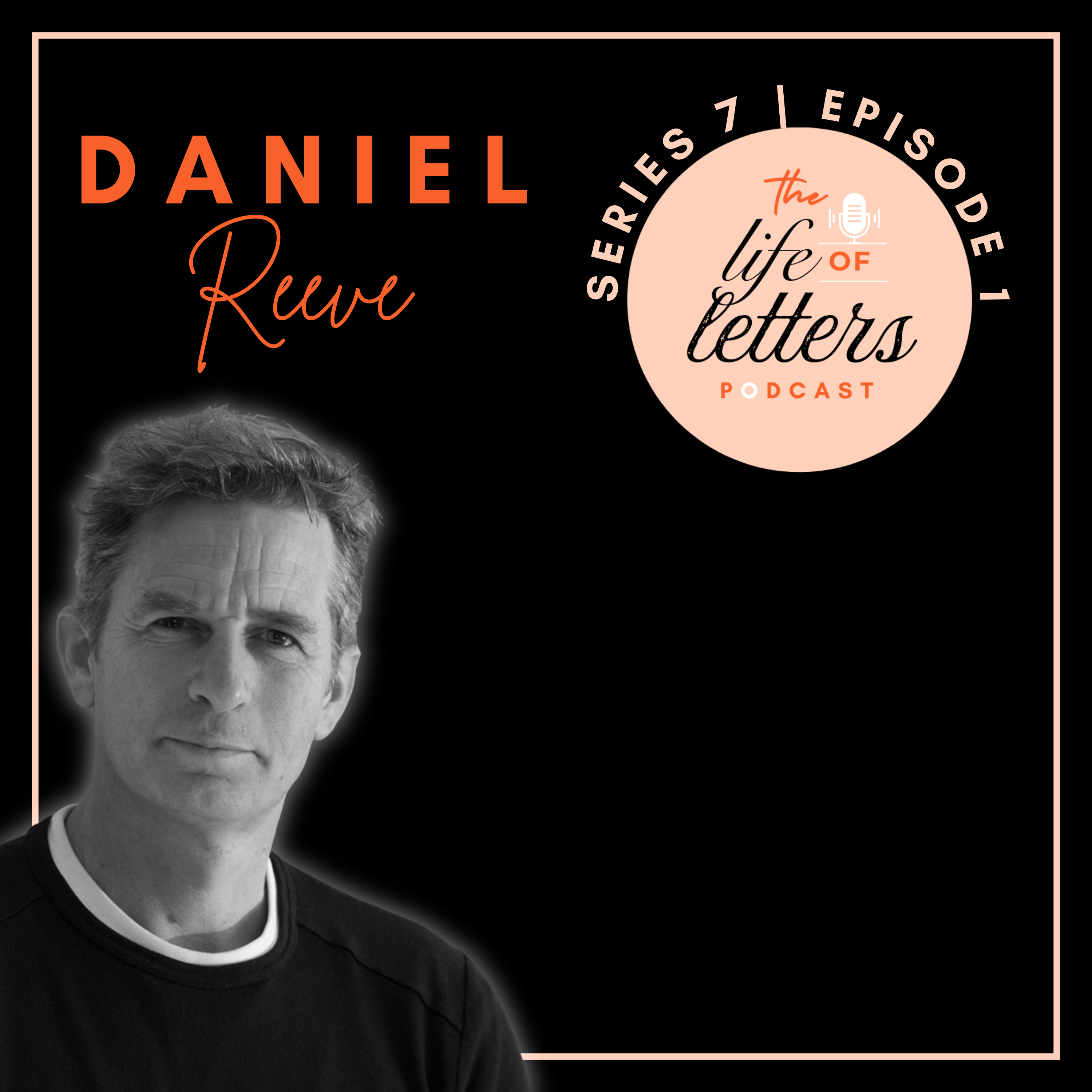
[00:00:45] Speaker B: Today I'm talking to Daniel Reeve, a freelance artist from Wellington in New Zealand. He is most well known for the calligraphy and cartography in the Lord of the Rings and the Hobbit films, but has also worked on many other films and TV series, plus their associated merchandise.
His art career follows several paths, including fine art, commercial art, illustration, calligraphy, typography, maps, movie props, and graphic design.
Wow. Just a very big, huge welcome to the Life of Letters. Daniel, it's lovely to have you here.
[00:01:19] Speaker C: Thanks very much for having me on the podcast. It's.
I haven't done one of these before just like this, so.
Looking forward to it.
[00:01:26] Speaker B: Well, it's great because we are literally at opposite ends of the earth. I was going to make a joke about being different ends of the earth, middle earth, trying to meet in the middle.
I'll weave it in as we go. We'll probably find a perfect moment for it.
But you've done an incredible amount of work across lots of different industries. And like all good stuff stories, I would love to just sort of start at the beginning.
What, for you was the spark that led you into your career as an artist?
[00:01:58] Speaker C: Well, I had had another entire career before this one, but for the calligraphy and Lord of the Rings in particular.
It all began when I was probably about 13 or 14 years old and my older brother was reading a book called the Hobbit and he says, dan, you got to read this. It's amazing. So I dutifully did what my big brother told me and started reading the Hobbit. Meanwhile, he's reading the Lord of the Rings. Dan, you got to read this. It's even better.
So time ticked on and I took his book and devoured the Lord of the Rings, immediately becoming fascinated with the runes and the elvish writing and just couldn't get enough of it.
Loved it.
But I was reading my brother's single volume paperback edition of the Lord of the Rings. And I discovered through my careful research as a 13 year old that this is supposed to be a trilogy of books.
So unbeknownst to him, I took to his book with a knife and cut it up into three pieces and recovered them and recalligraphed them and illustrated them.
And I don't know your listeners can't see this, of course, but I'm showing you my treasured possessions of my recovered calligraphed and illustrated books of the Lord of the Rings that I achieved by cutting up my brother's book.
So it has been with me for a long time. And a million years later, when Peter Jackson decided to make the film the Lord of the Rings, my favorite book, into a movie practically on my doorstep in Wellington, I thought, you know, what the heck, I'll give them a call. What I did is I made a sample piece of elvish calligraphy and sent it to them in the post. And my Phone rang immediately.
Mr. Reeve, this is Three Foot Six Film Company on the line. We'd like to speak to you about your calligraphy for this film. So I went out in my lunchtime from my job as a computer programmer in a bank in Wellington and headed into the film studios in Miramar, had an interview with probably Dan Henner, Grant Major and Nick Weir, I would think, and essentially came away from that interview with the job of being the calligrapher for the Lord of the Rings, bizarre as that may seem. I had thought, if you don't already have 500 Elvish calligraphers, perhaps I can give you a hand. And it seems like I landed in their lap at exactly the right time. They had some people who had done some background calligraphy, I think, for Bag End, but then I kind of landed in their lap and they thought, you know what, we haven't thought we needed a guide. And here he is. So there I was and the rest is history.
[00:05:22] Speaker B: That's incredible, isn't it? All those years later and they're making the film on your doorstep. Did you suddenly like, think, hang on, these are the books that I was already designing when I was 13 years old, I've got them here somewhere. Or, you know, is it just.
[00:05:40] Speaker C: It was one of many surreal moments, but.
And to be honest, at the time I still had to keep a roof over my head and feed a family and what have you. So my work on the Lord of the Rings was very much a part time, working in the evenings and the weekends kind of deal. And not until later, which we may get to talk about on this Podcast. When they asked me to do the style guide for the films, did it become a decision?
Do I stay at the bank for another 500 years or do I leap off into the unknown and become a freelance artist, which is what I did.
And then we get to the point where the rest is history.
[00:06:28] Speaker B: Wow. Okay. So it's so funny because in my head I was like, oh, you must have had this whole world around calligraphy and illustration, all this sort of fine art bubbling around you already as part of your career. And then the paths led you into Lord of the Rings. It was actually Lord of the Rings that kind of brought it to you. Right. And then it expanded. Is that. So your first sort of job in film was Lord of the Rings, but was that also your first path into developing calligraphy and lettering and illustration and things in that area as well?
[00:07:06] Speaker C: I had always had the art ability from 0 years old, and so have my children, and that's a genetic thing there going on, but I must admit, have a fascination with lettering and calligraphy during those intervening years. And I had bought and owned and used a little bit a set of calligraphy pens just to do what any hobby calligrapher would do and write labels on my spice jars and that sort of thing. So a hobby level, entry level kind of familiarity with calligraphy, but.
And a fledgling art career where I had already become tired of the rat race of working in a bank and suits and ties and what have you.
So it was in my head there was an art career ahead of me, but the Lord of the Rings connection kind of kicked it into gear and it took off from there.
So the threads were there, but it all came together at that point.
[00:08:26] Speaker B: Yeah, yeah. It was the thing that nudged you forward. And in terms of scripts, I'd love to dig into this a little bit more, but was Elvish was the kind of. I was going to say the audition. That's not the right. The sample. The example that you use, but was that the sort of start of then deciding what other scripts were needed and did that kind of just spin off from there
[00:08:56] Speaker C: the Elvish, I assumed, was what I would be doing all along, but in actual fact, what I did were more Roman Alphabet kind of things. You know, the script of the Hobbits and from Gondor and Rohan and what have you.
And although ultimately the film did end up having a lot of Elvish pieces as well, it wasn't the primary focus. And with good reason, because not all of the Lord of the Rings story is about elves. And for an Audience payback.
You want to present something that the audience can read themselves. So there are many reasons why Elvish isn't the main focus of the thing. It just, it's a beautiful looking backdrop to what's going on.
There are a lot, lot more important storytelling reasons for having various other scripts as well. So I think, as you said, my Elvish gave me the perfect job interview.
But having landed the job, there were many, many other things that it entailed, including maps, illustration as well. So Elvish starting point, but a lot of other stuff ultimately, yeah, lots more
[00:10:18] Speaker B: that people could actually read. Talking of reading, and this might be a really silly question, but for me and anybody else who might be wondering, is Elvish a language that people can learn? I know a lot of the languages from Lord of the Rings. It's a fully formed kind of real society, real writing systems. Is Elvish one of those?
Could you read it? Did you know what you were writing?
[00:10:48] Speaker C: That's a very good question. And the answer, in short, is that Tolkien developed two Elvish languages, both of which are used in the Lord of the Rings.
And although I know some words of it, my level of geekdom doesn't go to that extent.
I know how to write them. I can form the letters nicely. But if it's to be under the bonnet, if the language is to be Elvish, then someone will have to supply me with what it is that I should write.
So if you freeze frame a thing and decipher all the text that has been written, a lot of it is not in the Elvish language, it's simply in the Elvish letters.
But having said that, Tolkien did the same sort of thing as me in that the Elvish lettering system was just a general Alphabet in Middle Earth that various different races used.
So there are, for example, as described in the books, there are.
There's a book made by dwarves in which one of the dwarves writes using the Elvish lettering and another Dwarf writes using the Dwarvish lettering. So it was used by various different cultures in Middle Earth.
And in fact, the inscription on the ring itself uses Elvish lettering, but the underlying language is the language of Mordor. So I do the lettering, I don't do the language thing. And they're completely distinct. As you know, the Roman Alphabet can be used to write tens of thousands, hundreds of languages probably. And Cyrillic can be used for several, you know, several languages as well. And, well, Greek is just used for Greek. But a lettering system doesn't imply a language necessarily.
[00:12:58] Speaker B: Yes, and zooming in on that very Iconic ring. Like, I can almost see the video of it. And those who haven't seen the film, I can't imagine there's anyone listening who hasn't. But just in case they haven't, there is a very significant ring and it is sort of shining in gold and the letters kind of light. I was going to say light up. They sort of glow, right? They, they. They illuminate. That's the word at various points in the film.
How did that work? Were you part of that process? How were you involved in writing that and then it being created into the ring? I think is what I'm trying to ask.
[00:13:41] Speaker C: By the time I got to the ring writing, I was locked in as the calligrapher to do all this sort of stuff.
And that one was not really a challenge at all because I'm literally just repeating Tolkien's work. He presents the ring inscription in the book. We all know exactly what it looks like. So they just got their calligrapher to do it again for them.
Weirdly, they asked me to do it in white lettering on a black background, whereas I could quite simply have done it in normal black ink on a white sheet of paper.
And they could have digitally inverted it. But for some unknown reason, they asked me to do it in white on black, which I did.
And as I said, I was literally just doing my version of Tolkien's ring inscription, which we already knew. So iconic though it is, I feel like I get too much credit for that inscription because it was just a copy job, really was a small part in my involvement in the thing, but obviously a central and pivotal thing in the film.
So my little white on black cardboard copy was then used, digitized, and used to shine on Elijah's face as he reads the inscription on the ring and then to digitally engrave it on the ring itself with all the special effects and 3D and what have you to make it look as if it's engraved.
But my part in the ring inscription really was just do Tolkien's text.
[00:15:26] Speaker B: This is fascinating for us who don't get to see the sort of behind the scenes of how that will work. So although you're playing it down, that's still an incredible part to play. But I have. I have questions. So were you the only calligrapher working on all of these things? Because we're about to go into, like, a little bit of detail about the enormous amount of work that you actually had to do. Although the ring might not have been a big part, there were a lot of other documents, props and things that you having to do, does that mean that you were the only one? Did you have somebody else helping you? How did that work?
[00:16:07] Speaker C: For most of my career, it has just been me.
For the Lord of the Rings, I think I thought at the time that I was the only one. But they did have some people I know now who had done some background stuff for Bag End.
They had some other people who were doing inscriptions on weaponry and what have you, which I didn't know about at the time.
So as far as I was aware, I was the only one. And certainly the stuff I have done has become synonymous with the calligraphy of the Lord of the Rings in other films.
Once I was basically on their team, I ended up being the full calligraphy department, if there was such a thing.
So it does vary. And in fact, not until I did the Rings of Power did I finally get an apprentice who was this amazing young guy who took to it like a duck to water. And he was really good and helped me out a lot, not only in delivering the volume of work that they needed, but also giving it the visual variety that you are really after, so that it doesn't appear as if the one calligrapher wrote everything in Middle Earth. I myself was always trying to go for a variety of different appearances, and having an apprentice do some of this stuff for me helped in exactly that thing where he brought a different look to his writing than I did to mine, so it adds to the richness.
[00:17:58] Speaker B: So. And Rings of Power, for those who don't know, is the TV series, is that right? Yes.
And so how many episodes is that or how many series is that?
[00:18:12] Speaker C: That is still going as we speak.
[00:18:14] Speaker B: Is it?
[00:18:15] Speaker C: Oh, wow.
It started in New Zealand for season one and then for various reasons moved to the UK for seasons two and three.
[00:18:25] Speaker B: Stole it off you. I'm sorry.
[00:18:27] Speaker C: Yeah, no, no, no, it's. It's.
It's a strange thing, but if I.
Those who are involved with this thing are going to be involved for years to come, and I'm not sure if I've got that many years in front of me. So it's kind of a.
That's a shame kind of moment when it left. But in reality, it allows other things to happen, which I would rather be doing. So.
[00:18:53] Speaker B: Yeah, yeah. There's only so much Lord of the Rings. Yeah, I'm sure. I mean, we're not finished with it yet, but you probably are, so we'd love to know a little bit more about the Red Book and the maps. Can you tell us A little bit more about these kind of quite other significant props. The Red Book is the thing. This is the bit at the beginning, Right.
[00:19:15] Speaker C: I want to say, yeah, the Red Book is very significant from a storytelling point of view. It's provides to the audience a visual access to what's going on.
So accompanied with a voiceover by Ian Holm playing Bilbo, we have Bilbo writing and speaking as he writes his memoirs that way, provide an introduction to the audience about what's going on in Middle Earth. You know, who are the Hobbits?
What's their life like? What do they do?
And in the case of the Hobbit, who's Smaug?
Why don't the Dwarves like the elves? All these sort of things. And speaking of the Hobbit, there were moments.
Let's rewind a little bit. I needed to write in the Lord of the Rings to first establish the Shire, lettering the Alphabet of the Hobbits.
So we came up with an Alphabet which is kind of quirky and has accent marks on particular vowels.
And I needed to write it in Tolkien's words. Bilbo had a kind of thin, spidery hand. He wasn't a good calligrapher by any means.
And for the Lord of the Rings, I also needed to write in Frodo's hand who was more skilled and could write a flowing script.
So, A, we had to come up with the Shire script, B, have it written the way Bilbo would write it and then C, how Frodo would write it. And I had to be both of those people but also teach both of the actors how to write the script in their style.
So there was quite a lot going on there.
I luckily was given the opportunity to write the Red Book in my own words as Bilbo Baggins for the Lord of the Rings, being an example of the backstory involving looking back on the adventures of the Hobbit and then leading into the adventures of the Lord of the Rings.
And they said, here's the Red book.
Take it home.
Write the story of the Hobbit as if you were Bilbo.
And I knew the material, so I went home. Luckily, I had been writing this stuff using a quill because later on, unknown to me then we were going to see both Ed Larger and Sir Ian Holm write in the book in their styles.
So I had tried it with a fountain pen and with calligraphy pens and with a quill and settled on the quill because essentially, if you want something to look as if it's written with A quill.
The best thing to do is just write it with a quill. So this was new to me as well at that point, but I've sharpened many quills since then.
I took it home and just clicked into Bilbo Baggins mode and started writing this book in my words.
As I said before, I was doing this during the weekends and nighttime and at the end, I remember of my first week of writing the book, I flicked through it, reviewed all my work, said, ah, yeah, that looks good. I'm happy with that. Closed the book and on the back cover of the thing, as I shut the book, I saw the design, the front cover design, impressed onto the book and marked in silver.
So in a horrible moment I realized I had been writing upside down in the back of the book in this thing. I swear, when I took it home I thought, that's just a blank red leather bound book. And I just opened it up and started writing and without inspecting the front and back.
[00:23:18] Speaker B: We've all been there. We've all been there. Not to the kind of pressure and the weight that that would have carried, but wow.
[00:23:26] Speaker C: Yes. So it was a, a panicked phone call to the props master who said, okay, that's fine, bring it in.
And he gave it to his book bonus who pulled the block out of the book and turned it around and stuck it back in and gave it back to me. And away I went and wrote, I think about the first 30 pages of the book in Bilbo's hand and then later on wrote the last six pages of the book in Frodo's hand and as I said, taught each of those actors to do their calligraphy in their hands. That worked pretty well when the Hobbit came around.
The look of Bilbo's writing was already well established in the Lord of the Rings.
So we needed me to do that writing because no matter, it is a writing style that is as personal to me as your own writing is to you.
And try as they may, a different person's writing just does not look the same. So it was going to have to be my writing.
But my hands don't look anything like Ian Holmes hands, which we've seen 100 times on camera. So we couldn't get away with having my hand in the shot writing the book.
Nor could we have Ian Holmhead writing in the red book for the Hobbit.
His scenes were only shot in London and they were used for close up shots as he's doing his monologues.
So in the Hobbit, old Bilbo is played by four different people.
There's Ian Holm for the face shots and close ups.
Martin Freeman, who plays young Bilbo, also played old Bilbo for the wide shots, the outside shots on the steps of Bag End and what have you. Then there's Frank the hand double, whose hand looked exactly like Ian Holm hands. Four shots of dipping the quill into the ink, striking a match, that sort of thing was Frank the hand double.
And then there was me to actually do the writing on camera in the book where all we can see is the tip of the. The quill itself on a page.
[00:25:52] Speaker B: Right.
[00:25:53] Speaker C: And then stitch those four people together with a bit of movie editing and you've got Bilbo, old Bilbo Baggins writing this. Meanwhile in the book.
[00:26:02] Speaker B: Wow. All those people behind one character and probably not a lot of end scene. Right.
There's so much work that's going in behind a couple of minutes maximum, probably of all of this. But that's incredible. And yeah, just thinking about the level of not only have you got to create something that needs to be a character's, but it's also in your hand, but needs to be in somebody else's hand and embody the character of somebody else and potentially also do justice to Tolkien's words. You know, all of these things.
[00:26:43] Speaker C: True. And I think as well as that we couldn't use in the Hobbit, we couldn't use Martin Freeman to do it because I think they said he was left handed. So I wasn't able to teach Martin to do any writing. So in the end, yeah, it was the on screen writing is me, but there's four people playing the character.
[00:27:02] Speaker B: So I never thought we'd get a hand double into a podcast episode, but we have. How exciting. Frank the hand double. Wow. Big shout out to Frank.
[00:27:12] Speaker A: If you're enjoying this episode and would like to support the podcast, you can donate a coffee. Every contribution helps us cover the cost of producing and sharing these conversations and allows us to keep bringing stories from the world of letters to your ears.
You'll find the link in the show notes.
[00:27:27] Speaker B: Thank you for your support.
Now, let's get back to the episode.
So that's the red book and some exciting kind of behind the scenes of how that came together. And the maps.
Can we talk about the maps? Because there is just so much detail that needs to go into the maps. And this is now drawing on all of your artistic skill and talent to go into this. Are you. Are you creating every element of it? Like, what were you given to create these.
[00:28:02] Speaker C: So this is going back to the Lord of the Rings, where at the time I was simply the guy that was doing the writing.
And I heard the props master say that they needed the map of the Lonely Mountain from the Hobbit for a particular scene.
So I put my hand up and said, I can do that, I can do maps. That's fine. He said, sure, give it a go. I went home and recreated Tolkien's end paper drawing of Thror's map, the map of the Lonely Mountain, pretty much exactly as Tolkien did it, and then threw stains at it and creased it and marked it and aged it and distressed it.
Took it back into the studios the next week and showed it to Nick and he said, wow, fantastic. You can do maps. Awesome. Now do it again for me. This big and this big.
For the scale thing, he needed it, A, to be smaller and B, he needed both the scales, both the Hobbit scale and the human scale. Because everything I was doing for the Lord of the Rings and for the Hobbit had to be made in two scale, do everything twice.
So I went back home again and made the thing in two smaller scales with all the same stains, all the matching tears and creases and what have you. Took them back in to the studios and Peter Jackson said, you know what? Can you do a fourth version in which the mountain looks more like a mountain, but sort of rockier and more mountainous and with a livelier looking dragon. So I went home and made version four with the now famous Smaug flying over the mountain that you see in the films and with a rockier looking mountain, and that became the map which I then repeated innumerable times for the Hobbit as well.
So, yeah, pretty iconic. And then forever after that, I was the map guy as well, which. Which I think maps go hand in hand with with Tolkien's works and fit very well on. On a movie like that. So they made great use of them. And I made a prologue map as well at the end of the. That appears at the start of the film and again right at the end of the trilogy where there's a camera flying over the map showing the journey of the Fellowship at the end of the Falls and what have you. So it is very central and there were a lot of maps involved in the thing, as you rightly said. They involve a lot of illustrative techniques and ways of depicting mountains and rivers and seas and coastlines and what have you. So I really was in my element there doing, again, things that I had done as a kid, making, you know, treasure maps and burning the edges and that sort of stuff.
My childhood kept coming back and. And I couldn't escape from Middle Earth even if I wanted to.
[00:31:11] Speaker B: I love that. That's amazing. And, yeah, the echoes of the past, but the fact that you're having fun with it, I think that's.
That's incredible. And I guess plays into what the outcome is in the end. Like, of course, you must have had to tough deadlines and a lot of pressure, you know, not knowing how or where these were going to be used, but putting your hand up and going, yeah, I'll give it a go, I'll do it.
And going off and kind of dropping into that sense of, I guess, creative process and being able to tap into all those things that you have maybe had a go at but not felt like, right. That everything hangs on this. Is that.
[00:31:51] Speaker C: Yes. And in fact, I've done that throughout my art career. People will ask the phone and say, can you do this or that sort of script, or can you make this or whatever? And I'll always say, yes, of course I can. They put down the phone and think, oh, my God, how do I do that? And then learn to do whatever it is that they've asked for.
One example being on a small little film called.
Well, when I was working on, it was called the Legend of the Laundry Warrior. I think it became the Warrior's Way.
They wanted some little book written by the main character and in his just quirky kind of hand. And the examples they gave me were of some pointed pen work. And they said, can you make a messy version of this? And I had never used a pointed pen at that stage, but I just said on the phone, sure, no problem.
Went out, bought a pointed pen, learned how to use it, and I've used it many times since, of course.
But all of these things, you just take it on and say you can do it and then go and figure out how to do it. And away you go.
[00:32:58] Speaker B: It's a great way to do it. It's a great way to do it. You're not. Yeah, you're saying, yes. Knowing and trusting that you will work it out.
[00:33:06] Speaker C: And I think that necessity is the mother of invention. I think they say.
[00:33:10] Speaker B: Is that in Lord of the Rings?
[00:33:12] Speaker C: No, that's a.
[00:33:12] Speaker B: It should be true.
You've done so much work on these projects. But for you, I wondered whether there was a sort of standout script or particular prop or piece of merchandise that you yourself love the most.
[00:33:30] Speaker C: If I had been Able to take any of the things that I had created for the Lord of the Rings with me and kept it. I would have taken the red book mainly because, well, A, it's iconic, but. But B, is I was given complete creative license to do with it as I saw fit and to kind of make it my own.
They just said, here's the blank book, you know, the Hobbit, the story of the Hobbit, go and do it. So I did.
Illustrating it as I saw fit, adding little notes in the margins as I saw fit, crossing things out, correcting myself, you know, drawing the maps and the things in the book. It was just a project of creativity and it was used just as I supplied it. They thought, this is fantastic.
It was just straight from the heart, that book for me. So I would like to have kept that and in the Hobbit for the same sort of reasons. I would have kept the burglar contract, which grew from in the book being a contract containing, I think, three clauses, just a very small thing, single page, which I did and submitted in a thing they called the Night Pack, which was everybody's submissions to Peter, Fran and Philippa of the thing that they're working on. And the next morning you would get their feedback telling them, is it PJ approved or do you need to do this or that? And the feedback on my burglar contract was, can you make it a bit longer?
Okay, sure. So I made a longer version of the same thing and they also said, can you include the phrase not including. Including evisceration, incineration, this line that they had as a gag at the end of the film.
So I expanded the contract, included the little evisceration phrase, sent that off in the Night Pack and the feedback coming back was, okay, this is good. Can you make. Let's try a two page version.
So I did two page version of this thing, sent it off in a Night pack, it came back.
Let's make the writing smaller so we can fit more of it in smaller writing and more clauses. Just expand it.
So I made. What are we up to now? Version four, I think.
[00:36:04] Speaker B: Yeah.
[00:36:06] Speaker C: And I did it in this kind of dwarvish looking lettering, which was of course, the smaller you have to write, the more text you need to fill up that space.
So this was getting to be a big job. And I wrote all this text, showed it to the props master who said, what are all these little blank bits here? Fill them all up with script, tiny writing. So I filled everything up with writing and this huge amount of script Sent it off to the night pack and they said, let's go longer, let's go crazy, make it longer, have bits folding up.
[00:36:37] Speaker A: Just.
[00:36:38] Speaker C: Just go nuts.
And so I finally said, right, I understand you want a lot of writing. I will give you a lot of writing. And thus was born the burglar contract that you see in the film, which included all sorts of crazy clauses and the conditions and promising it all on the big lettering and clawing it back in the fine print. And just, of course, was authoring this. Not only writing it, but authoring it and making up these ridiculous clauses. Finally submitted that in the night pack and the word came back. Peter loved it. He took it home, he showed his kids. It's fantastic. It's PJ approved.
Now do it again.
[00:37:26] Speaker B: No.
[00:37:27] Speaker C: Yeah.
[00:37:28] Speaker B: Joy and torture all at once. Oh, gosh.
[00:37:31] Speaker C: The more important a prop is, the more copies they want always.
So you find yourself having done an iconic thing, having to do it again and again and again.
That's just. That's just how the movie world is. And so I did it again and then again. So there was a signed copy and an unsigned copy and a backup copy. And then a final time, I think, was as a gift for Martin Freeman at the end of the production, as his gift from the film company Upon Rap.
So if I was going to take something away from the Hobbit, it would have been that contract again, because I was given creative license to just do as I saw fit.
[00:38:10] Speaker B: And as you say, it's your words, you've created it, you've added something. It's not just seeing what Tolkien's written or seeing what was created before, or being given a design and recreating you, participating in the story and. And, yeah, being part of that world, that's incredible. That's. That's really special.
I hope that somebody from the film and the TV production teams are listening and send you copies of all of these things or, you know, reimburse you in. In prop kind that you kind of get these back to you at some point. I'm sure they're sitting somewhere lovely and.
[00:38:54] Speaker C: Yeah.
[00:38:54] Speaker B: Locked up.
Yes.
And I also know before we end that you've written, you've created lots and lots and lots of different elements and different scripts, and you showed me some of your incredible work before we recorded. And there was. Right at the end. It's like the style guide, which you've mentioned already.
Can you tell us a little bit more, just very quickly, about the style guide? Because it. It covers so many different styles of lettering.
[00:39:31] Speaker C: Absolutely.
This for the, for a movie of the kind that the Lord of the Rings is. That's the kind of movie that generates a ton of merchandise.
So film companies, when they make this kind of film, always produce a thing called a style guide, which potential licensees to produce merchandise must purchase the style guide and adhere to all the rules set out therein.
This is the approved lettering, these are the approved graphics, this is the approved packaging, this is what you must do with the logo. This whole kind of document that lays down the law for how you must present your Lord of the Rings product.
And so for me, as I said earlier, when I was working on the Lord of the Rings, it was just a weekend and nighttime part time thing while I still had a real proper job.
But when they'd wrapped the film and the new Line Cinema wanted to make their style guide, they approached me, they tracked down the lettering and maps guy and said, Mr. Reeve, can you do some work for our style guide for us for these films? And I said, show us your.
What do you need me to do? And they showed me a list which was a comprehensive list and included a lot of work I could see. And that was the point at which I had to make the decision, do I stay at the bank for another hundred years or do I jump off and be a full time artist? Which is what I did. Leap into the unknown, not knowing where your next paycheck will come from, but something always turned up. So for the first few years it was Lord of the Rings spin offs, including the style guide, which in their list needed alphabets, scripts, name treatments of the various people, races, events and what have you within Middle Earth in the story.
So they needed things in a Gondorian script and a Rohan script, and the way Orcs would write, or the way Ents could be presented, or the South Roms or the Easterlings. These many different characters and peoples each needed their own calligraphic treatment just to imbue their part of the world with some sort of flavor.
So this enormous list I just sat down and created, name treatments for all the different characters and this is how Elvish can be presented and what have you. Also on the list was they needed a map of Middle Earth for all publicity and merchandising and essentially to form the wallpaper of all the product packaging and what have you was this map of Middle Earth, they said, but they wanted 25 inches square. So I went out, bought a sheet of paper big enough to make a 25 square inch map, took it home and made the map of Middle earth on this $7 sheet of paper in my garage and did all the calligraphy, the line work and the calligraphy, then threw the watercolor at the thing to give it the coloring it needed and discovered to my horror, that I had chosen the wrong kind of paper.
Because to get the size they needed, I had gone out and bought a piece of what turned out to be printmaking paper, which lacks the sizing agents that watercolour paper has.
So this thing took forever to dry with all this watercolour on it overnight. And when I got up in the morning to have a look at what I'd done, found that the last piece of calligraphy I had done was just this bleed of red ink and another heart stopping moment. And there was no time to do this again. It had to be in New York the next week or something.
So I patched it up with acrylic as best I could and no one has ever knew. So I clearly did a reasonable job of patching it up.
So the lesson is, don't use printmaking paper if you're planning to rewet a piece of work and if you do, give it days to dry so that the ink will stay put.
And since then, of course, I've used to use, learned to use the right inks, the right papers, how to dry it properly, etc. And yeah, that was a bit of it, but that became. It was a strange thing to have drawn this map in my garage, sent it off, and then the next time I see it is on every action figure in every book, on every product in every shop that I encountered.
And knowing that it was the same throughout the world as well, it was just kind of a bizarre, surreal situation just before that film came out.
[00:44:30] Speaker B: And I'm looking at the map right now and it is incredibly detailed and actually a beautiful piece of work. Like, it's just stunning. But.
So this is the final version, but this is the one that you'd originally messed up or.
[00:44:49] Speaker C: Yeah.
[00:44:50] Speaker B: So this is. So you salvaged it. Yes. You kind of used your creative mindset to go, do you know what, it's okay, I can fix this and touch it up with some acrylic and play with this and that's. And do you see it and think, oh, gosh, no one, no one knows that it's. It had this history, this journey, or is it kind of.
[00:45:15] Speaker C: I look at it and I think it looks of the world.
It looks the way it should.
In fact, when I look at a lot of my calligraphy from the Lord of the Rings, It's a bit of a cringe sometimes to me because I've come so far since then.
I look back and I think, oh, did I really do it like that? But. But in the same breath I would have to say that what they're asking you to produce for a film is often supposed to represent the writing of the general population. There's an unskilled.
The Middle Earth isn't populated by calligraphers. So usually you are being asked to write something that the man on the street would write or draw a map that's completely utilitarian and just to be. It's got a purpose, it's not a decoration. So from that point of view, presenting something that's less professional is a plus, it's a bonus. It's a good thing because it makes it of the world. And to some degree, that merchandising map falls into that. It's done by hand, it's got mistakes, it's got a patched up stain, but it makes it sort of real and part of the world. And I look at it now and think, I don't cringe at it. I think, you know, I did a pretty good job on that and I probably would do it differently now, but whether that would come out better or, you know, it might lack the character that that thing has. So, yeah, we will never know.
[00:46:53] Speaker B: I love that it comes with so much heart and so much. There's like a story within a story behind it, which I think is really special when you're working on these things. I think it must just carry so much to deliver it and then see it presented all over the place and, you know, wow, what a special. What a special job of. What a special kind of part of your career.
And it's been fascinating to hear all these intricate ins and outs and details and secrets and myths and legends of. Of the. The Lord of the Rings world and. And your part in it. But this series, we are ending this episodes with a question which I hope is much easier than the rest of these, but what letter of the Alphabet do you feel holds the most magic or mystery and why? And obviously you've got several probably different alphabets bubbling around your head. So you can choose any of your alphabets that you know.
[00:47:52] Speaker C: Yeah, there are many.
And I immediately think of things like X and Z and.
Or even O, which is such a simple concept, but I'm going to say Q because it's a Q for like questions and queries and asking about the unknown. It seems to have a lot of those Interrogative kind of qualities, but also there's quantity and quality and it's unnecessary. You do not need a letter Q in the Alphabet. You could use KW or in many languages, just K to represent the sound that you're getting from Q. So it's kind of a strange letter. It's got a.
It's a capital letter with a descender on it. A descender that's not seen anywhere else in the Alphabet. So it's a funny kind of unnecessary, unusual shape, odd sort of letter. A misfit, I guess. So I'm gonna go with Q.
[00:48:54] Speaker B: That is brilliant. And I don't think we've had a Q before, and I think that's a brilliant reason why as well.
Yes, you do get drawn to cues and they are always in these fascinating words, aren't they? And, yeah, entirely unnecessary, but carries such mystery and magic with it.
Brilliant.
Yeah. I kept thinking quest and. Yeah. All these wonderful things. Yeah, yeah. Oh, it's been so lovely talking to you, Daniel, and for everybody listening.
To find out more about Daniel, you can Visit him at Danielreeve Co NZ, which is a website. He's on Facebook @Daniel Reeveartist and Instagram. Reeved.
Is that fair? Reeved.
[00:49:38] Speaker C: Yeah.
[00:49:39] Speaker B: DF. I don't know why I've changed it into a new word. Reeve. Df. Yes. Uh, but as always, we will put all the links and everything in today's show notes and see if we can get some nice images for people to have a little flick through, just to have some visual context. But a huge thank you, Daniel, for joining me today and sharing all these wonderful insights into everything that you've been creating. So thank you so much.
[00:50:03] Speaker C: You are very welcome. I've enjoyed it. Really cool. Enjoy your autumn evening while I enjoy my spring day over here.
[00:50:12] Speaker B: I will. I know.
And from the ends of the earth to Middle Earth. I should have done it the other way around. From Middle Earth to the ends of the earth. It's been lovely talking to you. Sort of got it in.
[00:50:27] Speaker C: Well done. Thanks, Laura. Enjoy.
[00:50:30] Speaker B: Thanks, Daniel.
[00:50:32] Speaker A: Thanks for listening.
Series 7 is made possible by my wonderful producer, Heidi Cullip, and the support of Speedball Arts. If you've enjoyed the episode, don't forget to subscribe, leave a review or share it with a fellow letter lover.
Say hi over on Instagram and watch clips and moments for all the series on YouTube at the Life of Letters podcast. And until next time, keep listening, keep creating and keep celebrating the life of Letters.