[00:00:01] Speaker A: Welcome to series six of the Life of Letters, a podcast exploring the art, history and future of calligraphy, handwriting, signwriting and all things letter related.
I'm your host, Laura Edrilyn, a London based calligrapher with a curious mind.
Six seasons in, I'm still fascinated by the stories hidden within the letters and the people who dedicate their lives to preserving, studying and creating them.
This season we're exploring letters through the lens of books, a library of letters, if you will.
As we begin another season of conversations and discoveries. I'm delighted that the Life of Letters is once again kindly sponsored by Speedball art, champions of craftsmanship and creativity, helping keep the life of letters thriving across generations.
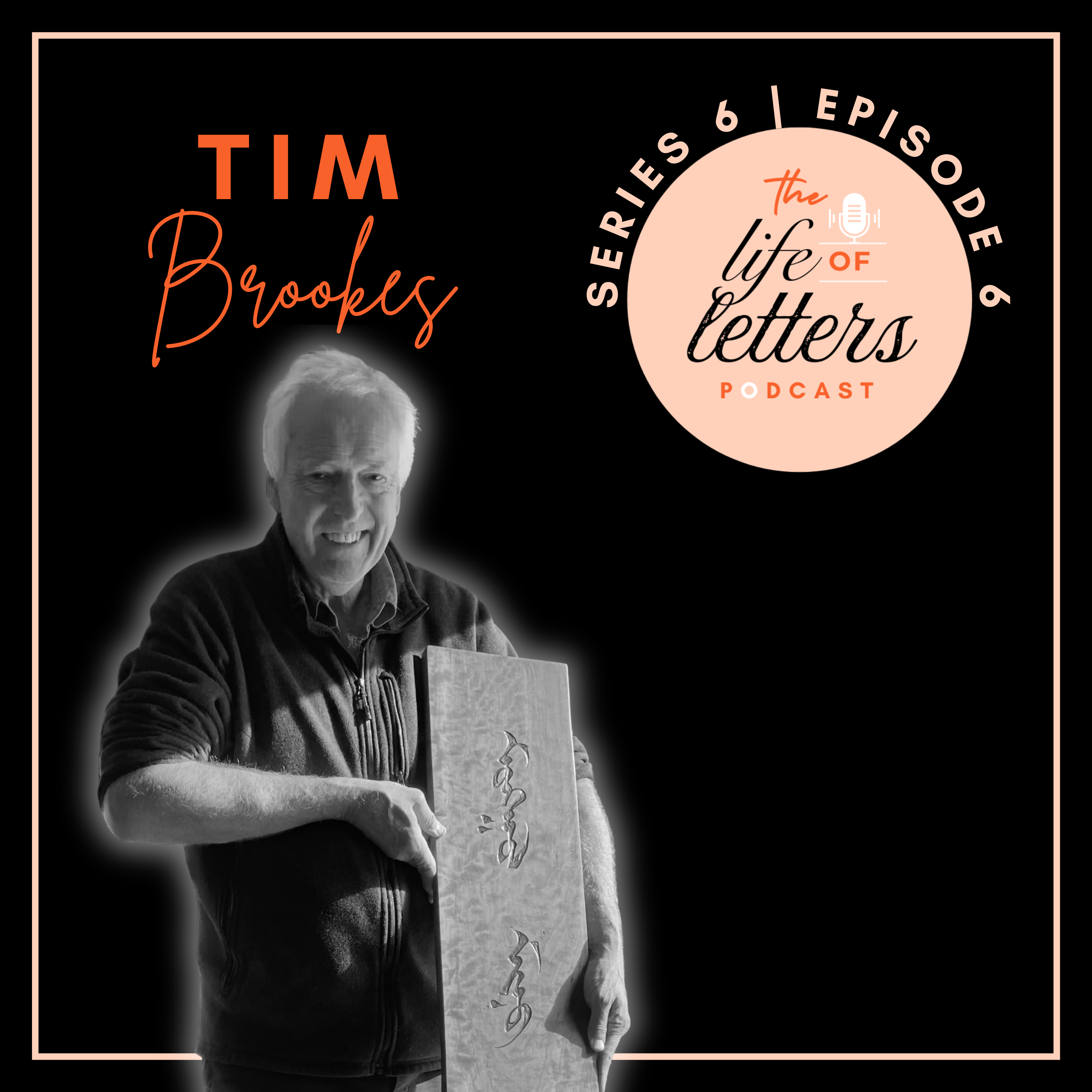
[00:00:53] Speaker B: In today's episode, I'll be speaking with Tim Brooks. Tim was born in London and now back in England after 50 years in the US. He is the creator of Endangered Alphabets Project and author of 23 books, most recently By Hand, A first person investigation of the nature and value of handwriting.
Welcome to the Life of Letters. Tim, it's so lovely to have you here.
[00:01:18] Speaker C: I am so glad you invited me. Thank you so much.
[00:01:23] Speaker B: Oh, it's a pleasure. And actually the first time I came across your work was at one of Jill Burke's calligraphy summits. So shout out to Jill for introducing and making the connection for me. Because you gave a talk on endangered alphabets and I was like, oh my goodness, this is a thing. I really want to ask you hundreds of questions.
So I'm going to try and rein in my enthusiasm a little bit and.
[00:01:47] Speaker C: Oh, I'm not, I'm not.
[00:01:50] Speaker B: And try and distill all of those questions down to one episode. Let's see where we get to. But I thought we could start by just getting to know a little bit about what this project is. So what is the Endangered Alphabets Project?
And also a little bit about the motivation for you behind starting it.
[00:02:08] Speaker C: Well, there goes the first 45 minutes right away.
[00:02:11] Speaker B: If you could just keep it really short. No, I'm not joking.
[00:02:15] Speaker C: So it actually began as a carving project.
Like all ideas of genius, it happened completely by accident and through no foresight of my own. I actually started by carving Christmas presents for members of my family and discovered that I really enjoyed carving wood. This was the Christmas of 2008
[00:02:45] Speaker B: and
[00:02:46] Speaker C: people seem to like them. And then I started carving Chinese characters because I find them sort of fascinating and beautiful. And then I stumbled upon omniglot.com, which is this website that has the world's writing systems, and I was just fascinated by how many there are that I'd never heard of, how many are clearly in decline or actively being suppressed or even banned.
And I thought I would carve a piece of text in some of these, 12 or 13 of them, as a way of just making them more solid, making them somewhat more permanent.
And so I did an exhibition of Those in Winooski, Vermont in May 2010.
And I, at that point I just thought it was a kind of pre. Senile hobby, you know, Tim has gone off on his own and he's doing this stuff with wood, you know.
But at the exhibition, people came up to me and said two things that I wasn't expecting. One was, this is art.
And I had rethought of it more as documentation, and I had thought of my mother and my daughters as the artists.
But people are saying, no, no, no, no, this is, this is really something. And the second thing they said was, this is really important. You have to keep doing this. And I cannot tell you what a wonderful thing it is to discover your life's work when you are in your 50s, because it suddenly makes the following years in your life just kind of open up with possibilities and energy.
[00:04:34] Speaker B: That's amazing. That's amazing.
What a way to start such an epic project. And I presume you didn't know at that point how big it was going to get.
[00:04:44] Speaker C: No, in fact, I assumed that I.
Well, first of all, I started carving. And it was only when I started carving that I started writing about it because I sort of write about everything I do, and I started keeping a journal and I assumed that there were books that I could read about minority scripts, and there was nothing.
And I summoned up my courage and contacted David Crystal, who is probably the English speaking world's primary linguist. He's written 100 books, including the Cambridge Encyclopedia of Language, and he's a wonderful person. He wrote back to me and said, I think you're the only person working on script loss, and I will write the introduction to your book, which was just amazing. And so that was my first book, Endangered Alphabets, which came out in 2010. And as you say, it was only when I started realizing that this was a field that I was essentially creating as I was going, that I realized one, this is. There's infinite possibility here, this is very exciting. And two, the world's written languages are in sad shape if I am the person in charge of taking care of them because I was so unqualified. You know, I wasn't a linguist, I wasn't an anthropologist. I hadn't even been a woodworker until, like, a few months previously.
[00:06:19] Speaker B: Wow.
And so what. What does the project look like now? So you wrote the book. Did that come first? And then has that expanded? Obviously, you've got the website and there's a resource on there and all sorts of brilliant things that people can delve into. But can you tell us a bit more about what. What happened next?
[00:06:38] Speaker C: So, yes, there are really a couple of really vital stages in the development of this. And I always say the endangered Alphabet's project is like a hedgehog, you know, it kind of sticks out in all these different directions. And. And this is why anybody who interviews me runs out of tape, you know, before we get done.
So the first thing I did after this initial exhibition was I tried. I wanted to do something a bit like a war memorial. And so I got these four very tall, broad pieces of maple and I created a poem.
I wrote a poem which goes, these are our words shaped by our hands, our tools, our history.
Lose them and we lose ourselves.
And I sent it out to people around the world who by then I had developed as contacts. And I got 20 different translations of this into minority scripts. So I want to make this really clear. This isn't just translations into different languages.
This is translations into different forms of writing. So I have a couple of them by my desk here right now, and anybody who walks in here is just astounded because some of them sort of look like writing, although completely different to anything that we're used to in the Latin world. But some of them just don't look like writing at all. They look as if they were taken from the side of an alien spaceship.
So that was an important development.
The second important development was that in 2012, I was invited to go out to Bangladesh to do some public health work, which was another of my hats at the time.
And so I asked around, are there any endangered alphabets in Bangladesh?
And I was told, yes. And I was given some contacts. So when I was in Dhaka in the monsoon season, people came to me from some of these minority communities, and they told me what it was like to be on that side of the canyon, the abyss.
So they live in an area called the Chittagong Hill Tracts, which is this upland area that's been farmed for centuries.
And when Bangladesh was created as a country in the early 1970s, they began. The government began driving these people off their lands in order to give those lands to Bengali settlers.
And if ever there was a conflict, like someone saying, I've lived here for Seven generations, you know, why should I move for you? Then immediately the military just came in and arrested or killed the indigenous inhabitants.
And the most vivid story I was told was by a guy who was a member of the Chacma peoples. And the Chacma are quite a numerous and very well established minority of about 1 1/2 million people who live in this part of Bangladesh, but also elsewhere in Bangladesh and to some degree in India.
And when he was a young boy, five or six years old, his father was the greatest living Chakma writer.
And he had Chakma books and manuscripts and things like, you know, collections of medicinal plants and all this kind of stuff.
And he said, the army came out to our village twice. The second time, they burned down the village and they killed my father.
And so he grew up not being able to read or write his own script. In fact, he barely speaks Chakma because in order to get ahead, and in fact, he had got ahead, he was a TV prod.
It was a question of using the national language and the national script. And so he had lost his family and his ancestry and his ability to read and write that script all in one go.
And that pretty much when that happened, I went from being somebody who was really fascinated and curious by this whole issue to somebody who realized that I need to be an activist, I need to be involved in this, rather than just kind of study it from a safe distance.
[00:11:15] Speaker A: Yeah.
[00:11:15] Speaker C: So now what I have is you asked where this got us to us now. So, yes, I have the main website, endangeredalphabets.com which basically says, this is what I do.
I have the online atlas of endangered
[email protected] and that came about because I would give these talks and people would say, this is fascinating. Where can I read more about this? And I would go, there isn't anywhere. So an intern and I put that together, and that contains about 200 of the world's roughly 300 scripts. And then I started a research project to try and find out just what are all of the various forms of writing that are used in the world right now, because nobody had ever done that, and there are probably about 300.
And at the same time, I started a thing called the Script Keepers Network, where people who are trying to either save their own traditional script or they've created a new one, because their culture has only ever had a colonial script imposed upon them.
So they can come to the network and then we can put them in touch with people who can help either by doing font Creation or graphic design or education or website design or, you know, all of those things that might help them with that process of revitalization.
And then it's also taken me in these other directions, such as, as you mentioned earlier, my interest in handwriting and how that plays into all of this. And probably. Oh, board games. Yeah, I forgot. I created some card games and some board games to not only to teach the script, but also to introduce something of the culture that the script is so deeply associated with.
Etc, Etc. Basically, you know, just something to do on a rainy Sunday.
[00:13:20] Speaker B: You know, I love it. This is just, you know, a sort of thing that's happening, I guess, and it's slightly snowballed, but in a way that is totally incredible for both. I mean, fascinating for you, but that ripple effect is now educating a whole world of people in. In something that is, as you say, there isn't. There isn't enough information around. Around a lot of these scripts. And I wondered if you could tell us a little bit more. You've mentioned one of the scripts, but what. Could you just give us a selection of some of the scripts that you're helping to preserve and. And some insights?
[00:14:00] Speaker C: So a really crucial thing happened right before the pandemic. So as I spending all of this time discovering these new, fascinating forms of writing, I have also been carving them and displaying them and talking about them. So I carved one of the Adinkra symbols from Ghana, and each symbol really represents a kind of a proverb.
And I carved it and I posted on Facebook and a very prominent linguist responded by saying, that's very nice, but it's not writing.
And I'm like, what have I done wrong? You know, how have I so badly misunderstood what this means?
And this was actually the basis for my book Writing Beyond Writing, where I realized that. That in the west, we define writing as, this is what we do, therefore it must be the best kind.
And what I had been doing was discovering all these other forms of writing. And I'll get to the answer your question right now, which in so many ways were more colorful or more spiritual or easier to learn or more consistent than the Latin Alphabet. And so when I talk about examples of scripts, as you asked me, I usually do it as a way of illustrating how narrow and also how blinkered we are in terms of our understanding of what writing is and what it could be. So, for example, I'm looking, just looking around my office here and right above, right above the laptop, where, of course, your listeners and viewers can't see it. Shall I Bring it down off the wall.
[00:16:03] Speaker B: Yes, because we can definitely show a clip of this. Yeah, let's do it.
[00:16:09] Speaker C: So this is a script called Siddham, and it's associated with Shingon Buddhism. The script itself was born in India and it migrated eastward and wound up in Japan. And now it's only used in Japan.
And the fact is that it's written in syllables and each syllable has a spiritual value, which is why it's often portrayed. This is a single syllable and it's rising out of the lotus, you know, the Buddhist lotus? Lotus.
So each syllable can be used for meditation for a particular purpose. I'm going to put this down because it's really heavy.
So there you might use a. Use and repeat a syllable for medicinal healing, for example, or for.
Or for calm or various other things.
And in Japan, you'll see in graveyards there will be these kind of sort of non. Headstone. Headstones where it will be essentially like a.
If you can imagine a cricket bat, but perhaps a little longer stuck in the ground and it'll have some Siddham syllables in it. And so that's part of the.
The kind of the unity or union between the departed and the spirit and their ancestors.
So that's one. Here's another one. So again, the whole notion that the very act of writing can be a spiritual act and a letter or a syllable, it's not just intended to represent a sound, it's part of a practice that transforms the person who's using it. You know, that's so much richer than our understanding of writing. So here is one that's perhaps even more remarkable. So this is.
This is drawn in sand with a fingertip.
And what it is, in a way, this is misleading because it implies that the finished design is the thing, but in fact, it's the story that leads to the design that is the thing.
So what happens is this is from Vanuatu in the Pacific.
And so a storyteller will begin by making a series of rows of dots in the sand and put this one down, because this is heavy and will then tell a story.
And as he's telling the story, he'll trace a line in the sand around these dots and never repeating himself. So it's really intricate but really, really beautiful. And that line is literally the storyline. And the twists and turns of the story are literally the twists and turns of the finger. And it's mesmerizing to watch because you don't know where it's going to go next. In the same way, you don't know where A story is going to go next, and when the story ends, it ends with the storyteller's finger coming back and completing the pattern. Because the thing about a story is that it doesn't actually take you anywhere different, but it leaves you changed. You've been on an adventure, you've come back to where you were, but you're now a different person to some degree. And so this really violates so many of our notions of writing. You know, we talk about writing as a means of making something personal, permanent. This is in sand. This is going to be gone. We talk about writing as a means of transcending geography, because we can send it somewhere else. This is only ever going to exist right there.
And the other thing is that it really emphasizes writing as performance.
And in the west and in the UK and the us, Which I know in particular, there is a sense that if a writer is a good performer of their work, they're kind of cheating. You know, it ought to be the writing that is the great stuff. And whatever you do in terms of performing, it is like a commercial thing or it's a childish thing or whatever. But what this really shows is that writing is part of a multidimensional activity, and the more dimensions there are, the more you can achieve with it.
And so the only equivalent I can think of in our culture would be animation, for example. You could.
Somebody has actually made some animations that you can see on YouTube, and even though they're very small and simple, they're just brilliantly evocative of just what this medium can do.
So, and I can give you a bunch of other examples which. Which exemplify other things, such as how a script becomes endangered, which is almost invariably because a more powerful culture subjugates a less powerful culture, usually A, because they're more peaceful, and B, because they have the good land. You know, they have the. The river valleys which are arable.
And so that means that those people then flee into the mountains or the forests or the deserts or the far north or south.
And their script is one of the things that reminds them who they are and gives them a sense that once upon a time they were somebody. And they still deserve respect. They still deserve a place to put their feet on the earth.
[00:22:20] Speaker A: Yeah, amazing.
[00:22:22] Speaker B: Wow.
Wow. I mean, my brain is firing in all directions. I wanted to ask, have you seen any of these alphabets? Obviously you're keeping them alive, but is there a sort of revival? Have you seen, like, a bit of a trend of people wanting to put them back into the world and start using them again.
[00:22:46] Speaker C: First of all, it would be nice to think that I'm keeping them alive, but actually, no, I'm, I'm doing a very small amount to help the people who are really doing that.
What I'm mostly doing actually is making people in the privileged world more aware that this is an issue and trying to connect people who are willing to help, you know. Anyway, so, yes, since I started the project, which as I say was 2008, 9, 10, there really has been this extraordinary global grassroots movement which is really about reclaiming cultural identity and agency and self respect.
And in many cultures, writing is a part of that.
And so there are, there are a number of groups that I know about and I've worked with some of them, but there are also individuals who are, depending on where they are and depending on their means, they may be making a YouTube channel to teach the script. They may be doing it with a blackboard and chalk.
The, the one, the, the, the most inspiring example is this group called Kalajatra in Nepal, where the traditional Nepal scripts have been not only marginalized, but outright banned for over a century. Anybody who was found writing them could be imprisoned and have their goods confiscated.
And that was also because there was a change of power, there's a change of religion. These things are always significant.
And so starting In I think 2019, a group of kind of community activists and type designers and calligraphers started running these guerrilla calligraphy workshops.
These pop up things where they would go into the bazaar, the market, you know, and they would put up a tent and pull up a table and teach people how to write their name in the ranjana script, which is the most elegant of the traditional Nepal scripts. And they post a lot of their stuff on Instagram and Facebook. And these photographs are just inspiring because you'll see people, you know, some of them are kids, some of them are just like, you know, manual workers.
And they've written their name and they're holding up the camera and the look of delight and pride on their faces is transforming. It's just incredible. And they kept that going even through the pandemic and, and they're still doing stuff and it's sort of expanding and other people are learning from.
There's groups in the Philippines, there's groups in India. You know, it's, it's super inspiring to see what, what they're doing. And essentially one of the other things I did was I created World Endangered Writing Day. That was David Crystal's suggestion as well.
And so each year when that happens in January. I give awards to people who've played on organizations that have played significant roles in this, because otherwise nobody would know.
[00:26:29] Speaker B: Yeah. And what a lovely thing to do to celebrate and bring. Bring that forward as well. And, and for the work that they're doing in all of these places. Right. It's, It's. That's amazing.
That is really inspiring.
[00:26:44] Speaker A: If you've been enjoying the life of letters, I'd love it if you'd hit subscribe wherever you're listening today. It's a simple way to support the podcast and, and make sure you never miss a new episode. And if you know a fellow letter lover, why not share it with them, too?
Now, let's get back to the episode.
[00:27:04] Speaker B: I wanted to ask you a little bit about your books because you've written over 20 books, which is incredible, and I just wondered whether you have it. After a while, you're just knocking them out.
Can you tell us a little bit about the latest book? That's by hand, right?
[00:27:22] Speaker C: Yeah, yeah, yeah.
[00:27:24] Speaker B: So
[00:27:26] Speaker C: I see the recent, say, five years of my endangered alphabets work as this trilogy. So the first one is the book, the print edition of the Atlas of Endangered Alphabets, which is now, there's a Japanese edition, there's an Italian edition. It's sort of getting out there.
And in a way, that's the beginning because it sort of says, hey, these things exist, and they're really interesting.
Writing beyond writing went beyond that by saying, okay, but what does all this tell us about writing itself?
Because there's actually a strange and vast black hole in terms of things that are studied and written about and researched at the, at the university level, and writing is in it. So writing turns up in terms of what gets written. So you study literature and it gets. Turns up a little bit in, for example, anthropology, where you say, in this particular culture, they do this. But the whole notion of looking at writing itself and saying, what is it? How does it work?
Is massively understudied. So that's what writing beyond writing is about.
And as a result of that, and as a result of the fact that, as I say, in these revival movements, one of the things that's quite common is that people teach calligraphy. They, they.
They have these calligraphy workshops, and people learn to write their traditional script, and you start realizing this isn't just calligraphy, as in, you know, I can make this pretty f.
This is. These are the gestures that my ancestors made. This is the posture my ancestors sat in. This is the palm leaf that my, My Ancestors wrote on back in the day before we stopped using palm leaves.
And it's absolutely a part of reclaiming that identity in that culture. But as I'm looking at this, I'm thinking exactly the opposite is happening in the west, where handwriting is.
Is being deemed as clumsy and slow and messy and backward and primitive. And if anybody has any sense, they use a keyboard, which means they can save it and they can send it everywhere and they can transform it and whatever.
And I thought, this is really, this is a moment in history right now where we are in danger of throwing out something that we don't understand.
And yet as a species, we have been kind of co evolving with and co developing because it's been developing us and we've been developing it, you know, for thousands of years. And yet the whole idea is like, oh, that doesn't matter anymore. Bam.
And so I thought, I want to write about this. And then I thought, I should write about it by hand. The book is called By Hand. I Wrote by Hand By Hand.
It's almost a bumper sticker.
[00:31:01] Speaker B: And
[00:31:04] Speaker C: that was a fascinating experience because most people in the west learn to write by hand when they're very young.
A number of them continue to write in schooling, for example. But it's a really unconsidered thing.
And what I began discovering was that handwriting is under our noses, and yet it's under the radar.
People are so accustomed to it and almost contemptuous of it that thinking about it is in itself a new thing.
And so as I was writing this book and as I was writing in my journal, all this kind of thing, I'm sort of looking over my own shoulder and saying, why do you have such difficulty writing this phrase?
Why does your handwriting change from place to place on the page?
Why does it change depending on the time of day? And then some really interesting questions, like if you've just been writing on your laptop for 45 minutes and you start writing by hand, why is your handwriting absolutely indecipherable? What has happened to you in terms of brainwave activity and in terms of biorhythm, that this should have happened? And then on another occasion, for example, when I had all these ideas, I wanted to write and I got to this cafe where I was writing, and I realized I'd left my journal at home. And so I thought, well, I've got to get them down because they're so interesting. So I typed it up and I thought, this is terrible writing. This is like, there's bullet points in there, for heaven's sake. You never use bullet points.
And then you start realizing that the way you write is conditioned by the tools that you use and what else you use them for. And the fact that while you're writing, you're getting emails coming in or you're getting alerts or, you know, the stock market called and said you just went bust or whatever, you know.
And so I went home and started from the same point and wrote the same ideas by hand with my nice pen in my journal.
And the writing was completely different. It was fluid, it was imaginative, it was rhythmic.
Ideas occurred to me that hadn't occurred to me before.
And I thought, this is an utterly extraordinary thing because once again, as a writer, you always want to come across the subject nobody else has written about.
And this is the thing that not only has nobody else written about it, but everybody knows it, but doesn't think about it. And so every time I give talks or run workshops on by Hand, everybody says, this is incredible. It's right there. But I had never thought about it.
And I also began discovering the relationship between handwriting and health, and handwriting and mental health, you know, just by what it was doing, the process was doing for me. So it was. It's the most subjective book I've ever written, and it was the most disturbing book I've ever written because I had to constantly look at my own handwriting, and it was never good enough.
And that's what everybody says. You know, you say to people, do you ever write by hand? They say, oh, yeah, but I have terrible handwriting.
Four different people said to me, I've been told I have the handwriting of a serial killer, and their handwriting were nothing alike. This is just, you know, what you get from watching thrillers on TV where they bring in the forensic expert who says, ah, yes, you see the way they wrote the letter S. Yes. Doubtless this is the person who murdered the 17 nurses and dump their bodies in the canal, you know, which is such nonsense. But writing does tell us an enormous amount about ourselves. It's a kind of mirror that once you start doing it, you think, oh, as I'm. I can tell that this is what's going on inside my. My mind, my body, my psyche, just by looking at the way that I'm writing.
[00:35:36] Speaker B: Wow.
Yes.
Yes.
And you're right, you, you know, I dabble a little bit in a bit of journaling, and I can tell when I'm tired. I mean, that seems fairly obvious thing to say, but you can see your writing's chaotic. I'm spelling everything wrong. Like, everything's sliding off the page and my pen's just running away with me and there's no sense of control.
But there's also this much more intentional process that I think we don't explore enough, and I think that's fascinating. And I think there's a, there's a whole. Well, the fact that you've written a book on it suggests there's a lot more that we need to dive into.
That's really exciting. And people can buy your book that it's available now, right?
[00:36:25] Speaker C: It is available, but at the moment it's only available through my website because I have decided that Amazon is a major supporter of Trump and, and Jeff Bezos has made such enormous sums of money off the pandemic, apart from anywhere else, that I just don't want to have any of my money or my reader's money go to him.
So the. If you go to endangeredalphabets.com and you click on the Shop link link, then you can find writing beyond writing and by hand there.
And by the way, the journaling you were talking about, there's now an extensive body of very solid research that shows that people who journal in an intentional and regular fashion are significantly healthier, not just only in mental health, but even in things like the rate at which they recover from major surgery, the, their progress when they're facing hiv, AIDS or cancer. It's clearly, there is this extraordinary thing going on here that we don't understand and that hasn't been researched because again, handwriting, it's just like, oh, it's just what everybody does.
It hasn't been realize just how complex and how deeply rooted it is in us.
There is one neuroscientist I found who said the act of writing by hand may be the most complex and the most developed activity the brain is capable of.
[00:38:11] Speaker B: Wow, that's incredible. It makes me want to go and get a degree in psychology to understand all of this neuroscience. I'll just become one that's. It's, it's fascinating. It is absolutely fascinating. And I think what we can do is put some links to, to various resources and anything that you suggest people go off and have a look at across all the different elements as well. But so from the endangered alphabets and also with the handwriting, because there's almost two, two topics going on, very much related. But I wanted to just ask a couple of questions before we wrap up. One on, obviously you create these pieces of artwork. So do you. Are you commissioned to do these or are these just sort of things that you're doing yourself these. The wood. Wood engraving.
[00:39:01] Speaker C: There's really three different.
Genesis, I suppose you would call it.
One is that I just love doing this stuff. And when I come across something new and interesting, I'm just going to do some carving with. Without any clear sense of what's going to happen to that. And it may become part of an exhibition or I may go off and give a talk and I'll hold it up and people can, you know, pass it around.
The second thing is that every so often I actually do a thematic activity and try and get it supported through Kickstarter. So I'm doing one right now where I'm doing the.
The injunction to write or to go out and write or to.
To Write now in 10 different endangered scripts. And I'm going to send those carvings out to their cultures of origin where they can see them up on a wall.
And in many cases, these people never see their own writing because they don't have the resources to. To print stuff or to, you know, they're certainly never going to be on a TV channel or they may well not have a newspaper in their script. So that's one of the ones I'm working on right now.
And then the third thing is, yes, I do get commissioned. I wish I got commissioned more often because I love doing it.
So just recently, for example, I made a bench for a friend of mine and it says trust in yourself in a vertical Mongolian script, which is absolutely beautiful and endangered.
And I'm doing one, I'm starting actually later today, which is a birthday present for somebody that I've been commissioned to do. I can't tell you any more than that in case the birthday person hears about it.
[00:40:52] Speaker B: Top secret.
[00:40:54] Speaker C: Yes, exactly. But that's actually going to be the poem that I wrote way back 15 years ago in a minority script from Indonesia. And I'm also. I also do furniture. So I don't do big furniture because I don't have the skills or the equipment, but side tables and coffee tables, I love doing those. And they are, you know, as you would expect, they're really unique, but they're also. I choose really beautiful woods and they're really pretty astonishing, actually.
[00:41:30] Speaker B: That's incredible. And what a lovely way to bring these two kind of facets together. Right. The scripts that you're exploring and, and, and finding out about and sharing, but also being able to sort of visually and artistically process them and, and, and, and put them together in, in all these lovely ways, which is amazing.
[00:41:51] Speaker C: Yes. I just tell people, put a Coaster down first before you leaping heart on this thing.
[00:41:56] Speaker B: Don't sit on it. Yeah.
Our final kind of question for our episodes is this very challenging question when it may actually be even more challenging for you, which is what is your favorite letter of the Alphabet and why?
I don't know whether you want to share.
[00:42:19] Speaker C: Yeah, no, I've got a great few.
[00:42:20] Speaker B: You've got one?
[00:42:21] Speaker C: Yeah.
So when I was writing by hand, by hand, there was one point where I realized that I could not write the letter G. And I've got, in the book, actually, there's a photograph of a page in my journal where I wrote the letter G 20 times. And I hated all of them.
And after the book came out, I started running workshops.
[00:42:49] Speaker B: And
[00:42:52] Speaker C: in these workshops, the atmosphere was really interesting because although people were interested when they heard that they were actually going to have to write something by hand themselves, everybody got really self conscious and gloomy and it's like, oh, you know, I hate my handwriting, etc.
And I said, I want you to write one word.
I want you to write the word giggling. And the point is that nobody, except maybe a professional calligrapher, would write the word giggling in such a fashion that all four GS were identical.
In fact, when you write a G in particular at the beginning of a word, you typically do it differently than if it's at the end of the word because the descender wraps around and heads over towards the rest of the word. When you have the let two. Two of them side by side. There's something about it that means that you cannot possibly bring the same degree of intentionality to both of them. So they're bound to be different. And they're different side by side. You kind of go.
And then the G at the end. Often people kind of wrap it back up and around as if it's cocooning the whole word. Anyway, so I had them do this and then I said, okay, I want you to show your stuff to each other.
And it was fascinating because the entire atmosphere in the room changed.
Because instead of people looking at their own writing with that critical eye, maybe the memories of their teacher when they were seven years old, you know, criticizing their writing, they were now into something that I call the beta verse, which is the fact that there's the Alphabet where every letter is supposed to look like this. And then there's the beta verse, which is every letter is different every time you write it. Everybody does it differently. Everything is elastic and all of it's permissible. And they would look at each other's and they would say, oh, you do your G like this, I do mine like this. And they were happy and they were talking to each other about writing and they were realizing that everybody is kind of a gift. So when you write by hand, it's like a gift of self that you're giving to other people, to your reader, to whatever. And that's what it became. So it went from this angst ridden, fraught mental state to this kind of joyous celebration. I had to stop them after about 10 minutes, everyone still happily babbling away and looking at each other's writing and talking things, noticing stuff like, oh, yeah, you do the dot over the I, but it's over that side. You know, when I do the dot over the I, it's actually behind.
And they're doing all of this discovery. And so G has become my favorite letter because it is, you know, that rhythmic gymnastics sport where you have a human being with a stick with a ribbon on the end of it? Well, that the loop of the G is pretty much straightforward, right? But the descender and what you do with it, there are so many different things you can do with it that it's like the ribbon on the end of the stick in the rhythmic gymnastics and people are going to do different things with it. And so it shows just how much pleasure you can get from articulating a letter on paper.
And you don't even think in those terms. If you think of writing just as an information technology or if you think of writing as being something which is supposed to look like this, but you can't do it like that anymore, Maybe you could when you were nine or whatever, and you suddenly kind of go, whoa, this huge ocean just opened in front of me and it's all, all mine. It's all everybody's. We can do this.
We can explore this ourselves.
[00:47:06] Speaker B: Yes, yes, yes. I'm sat here going, yes, this is amazing. And, and I think that shift in emotions is, is something that's really special and something that, if people can explore that in a workshop and come away going, feel entirely different, I have a completely different mindset to handwriting or my handwriting or, you know, and actually even encouraging people to pick up a pen more often and to put it to paper and see what happens, I think that's a, that's an amazing experience for, for all human beings.
I want to flag with everybody that they can find out more about you and the project by visiting endangeredalphabets.com endangeredalphabets.net or on Instagram @enangeredalphas.
Is that right? Yes, but we will put all the links in today's show notes. Anyway, anything else that you wanted to add in? I mean, you know, we're scratching the surface really, of a conversation that could go on for hours, but anything else, Tim?
[00:48:18] Speaker C: So one tiny thing.
Just recently, a couple of weeks ago, a calligrapher and an ethnomusicologist and a DJ and I as a guitarist did this thing called Jimmy Graphy where we played music while people wrote on walls and we, they, you know, big sheets of paper, etc. But the whole idea was that writing is an embodied rhythmic act.
So what if we provide you with this musical environment that has a tremendous sense of rhythm to it and we provide you with all these different kinds of writing tools? How does that affect the experience of writing? And that was a hoot.
So anybody who's interested in hiring the Germigraphy gang, get in touch with me.
[00:49:08] Speaker B: That is. That's incredible. That really is multidimensional and that's sensory experience completely opening up. Yeah, that, that whole exploration of, of writing. Wow.
Incredible. Tim. Oh, thank you so, so much for talking to me and thank you for being a part of the life of letters. A huge part of the life of letters as well, in, in all ways and all the work that you are doing and, and raising awareness of all these incredible alphabets around the world. So thank you, thank you, thank you.
It's been a pleasure talking to you.
[00:49:41] Speaker C: Absolutely. And thank you so much for inviting me and asking great questions.
[00:49:45] Speaker B: Thank you, Tim.
[00:49:48] Speaker A: Thanks for listening. Series 6 is made possible by my wonderful producer, Heidi Cullep, and the support of Speedball Art, whose commitment to high
[00:49:56] Speaker B: quality tools and creative tradition continues to
[00:49:59] Speaker A: serve, partner and deliver to artists all over the world. If you've enjoyed the episode, so don't forget to subscribe, leave a review, or share it with a fellow letter lover. And until next time, keep listening, keep creating, and keep celebrating the life of letters.