Episode Transcript
[00:00:01] Speaker A: Welcome to series six of the Life of Letters, a podcast exploring the art history and future of calligraphy, handwriting, signwriting and all things letter related.
I'm your host, Laura Edrilyn, a London based calligrapher with a curious mind.
Six seasons in, I'm still fascinated by the stories hidden within the letters and the people who dedicate their lives to preserving, studying and creating them.
This season, we're exploring letters through the lens of books, a library of letters, if you will.
As we begin another season of conversations and discoveries. I'm delighted that the Life of Letters is once again kindly sponsored by Speedball art, champions of craftsmanship and creativity, helping keep the life of letters thriving across generations.
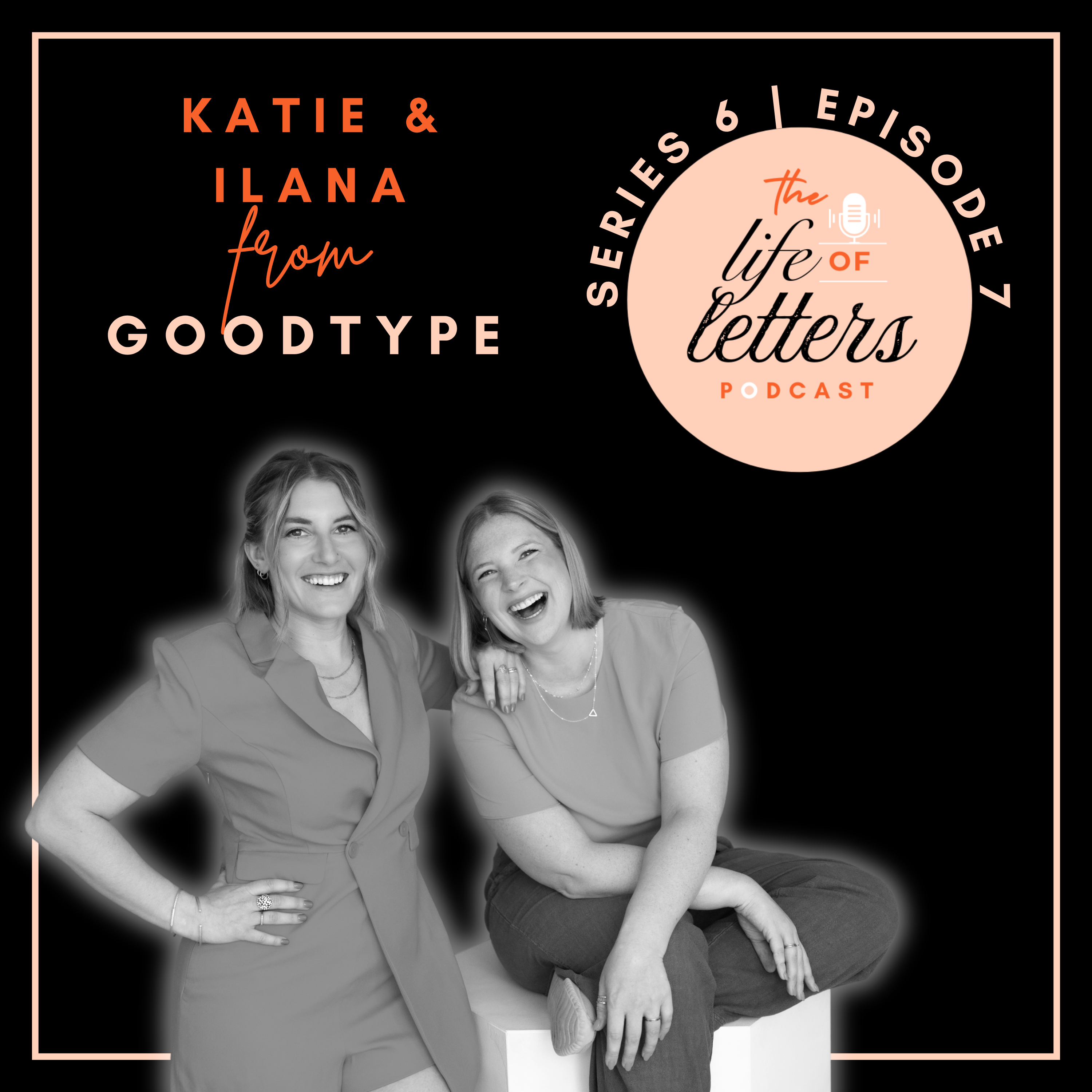
[00:00:54] Speaker B: In today's episode, I'm delighted to be chatting to Katie Johnson and Alana Griffo, who are artists and authors and the creative duo behind Good Type, a design studio and an educational platform that supports a community of 1 million artists. Together, their portfolio is full of quirky puns, colourful patterns and approachable designs packed with juicy details. Their newest book, Follow youw Art, has been written to help you uncover your own creative voice and make your most authentic work.
Outside work, you'll likely find either of them petting a dog, which I absolutely love.
Katie, Ilana, welcome to the Life of Letters. It's so lovely to have you both here.
[00:01:33] Speaker C: Hi.
[00:01:33] Speaker D: Thanks.
[00:01:34] Speaker C: We're so excited.
[00:01:35] Speaker B: Yay. It's a duo. I haven't spoken to a duo in ages, so there's three voices.
[00:01:40] Speaker C: You're in for a treat.
[00:01:42] Speaker B: I need, like, one of you to have a really deep voice, one of you to have a really high voice.
Thank you, Katie.
[00:01:50] Speaker C: Absolutely.
[00:01:52] Speaker B: But maintain this all the way through.
Yeah.
[00:01:55] Speaker D: Have fun. Katie. She does have the theater background of the two of us.
[00:01:59] Speaker C: I do. Can you tell?
[00:02:00] Speaker B: That's what we need. This is why it's the perfect duo.
But I want to get straight into the juice, as it were. How did you guys meet and where did your creative paths become one?
[00:02:13] Speaker D: We truly have become one. It's funny because if you see us in person, we have started to look alike, which schmelding is what I've always called it. And. And it's like when you and your
[00:02:24] Speaker C: diaper start to meld together.
[00:02:26] Speaker D: Yeah, we've really. We've. We have become one. And we finish each other's sandwiches. Yeah, There we go.
[00:02:34] Speaker B: I like it.
[00:02:35] Speaker D: Thank you. Okay, so Katie and I met back in like 2017.
I slid into her DMs as like any modern day romance starts. I just slid right in there and Katie had posted about wanting to do a class on art licensing. And I was like, oh, that's so cool. Can't wait to take it. Love your work. And she wrote me back and was like, why don't we just do it together? And I was like, yeah, let's do that. And from there, we started working together, and it was like a slow roll. We did one course, and then one day, Katie just sort of said to me, I guess we're starting a business together. And so we did.
[00:03:13] Speaker B: Yeah.
[00:03:13] Speaker C: It all weirdly fell into place, and it was like the universe was just pulling us together.
[00:03:19] Speaker D: Yeah.
[00:03:20] Speaker B: As much as you resisted it, it was like, no, no, you too.
[00:03:24] Speaker C: Yeah, exactly.
[00:03:25] Speaker B: I love that. Amazing. And have you both always been artists?
[00:03:31] Speaker D: Yeah.
[00:03:32] Speaker C: Yeah. It took me a while to get to call myself a visual artist. Cause I was. I've always been creative, but I was more on the music side of things. Both of my parents have a music background, and I grew up singing and, you know, all the things, mostly singing. And I really thought that that's where I was going to end with my career. That's where I thought I was going to end up.
I got exposed to graphic design, like, my end of my junior year of high school, and I was like, what is this?
And the universe, again, pulled me in a different direction.
[00:04:09] Speaker D: Yeah. And I have a sister who is a fine artist. Like, she is a ceramics teacher, and she's one of those people that can pick up any craft. It's like a musician. She's good at any craft, any art form. She'll just pick it up and have fun. So I have definitely intentionally, really set myself as a designer. Like, those are the things that make my sister and I different. Is, like, I really enjoy the. We called it before we kind of knew the difference. Like, I was more of a clean artist and she was the messy artist. And that still rings true. Her studio is a lot of fun to go to. But, yeah, Katie and I had weirdly similar paths of kind of when we discovered graphic design. Why we fell into. And then our jobs after that. And when we started talking, we were both freelancing and doing basically the exact same thing in different parts of the United States and started working together before we even met in person. And so it really often feels like serendipity or kismet or, like, just, I don't know, fate, I guess, because just the stars sort of aligned. And we just have been a really great duo for each other. I think we make each other better and stronger. But definitely when we decided to work on the class, had no idea how similar or how complementary our skills would
[00:05:21] Speaker C: be for each other or that any of this would ensue.
[00:05:25] Speaker D: Yeah. We were like, yeah, let's just do this one thing.
[00:05:28] Speaker C: Yeah, yeah. Collaboration changes lives, people. I'm telling you, it's a game changer.
[00:05:34] Speaker B: And has your sort of individual lettering styles changed since you first met?
[00:05:39] Speaker D: Yeah.
[00:05:40] Speaker B: Really?
[00:05:41] Speaker C: Yeah.
[00:05:41] Speaker D: Yeah, go ahead.
[00:05:43] Speaker C: I was just gonna say, I think, you know, we both have the essence of what came with, and I think that's, like, evolved in an interesting way. But we also have had the challenge of, like, we work together on our art. Now we've started, you know, a studio where we both pitch in to create the final products. And so in the process of figuring out how we come together, we've learned a lot about ourselves, and we've learned how to unlock the things that work together really well.
So I think, like, the hallmarks of each of our styles that we bring is I'm really into the fine details, and I really like living in that place. And I also really love, like, ornamentation, and I gravitate towards specific styles of lettering when I do lettering. And, Alana, what do you feel like your style's at right now, or, like, how do you think it's evolved?
[00:06:40] Speaker D: I spent a lot of time trying to, like, escape from doing things digitally, and I'm now at a point where I'm kind of back to my roots, and I feel like I do so much more that's, like, vector driven. And so that's been a fun experiment to figure out, like, not. I don't want to say you're getting more analog, but you're. You're really leaning into those handmade details, and I'm doing the opposite. So finding that middle ground has been really fun, and I feel like it's only helped us to find our own voices and make them stronger. And so I actually tend to be involved in the. You know, we're both creative directors, we're both art directors, we're both junior designers on every project we do. And I tend to kind of just defer to Katie right now on the lettering, and I tend to come in more in the design side of things because I just like what Katie does when it comes to making letters by hand. And so it feels weird to say, like, I'm not doing as much lettering as I used to, and I feel kind of good about that.
[00:07:46] Speaker B: Yeah, I mean, that's great.
[00:07:48] Speaker A: Go on, Katie.
[00:07:49] Speaker B: Sorry.
[00:07:50] Speaker C: No, I was just going to say Alana comes In with, like, a lot of the. The kind of elements that will integrate or surround the lettering. We've been kind of embracing this maximalist minimalism that, you know, we both are really drawn to certain forms of maximalism. And then Alana brings it back, brings, like, the little minimalism bit in there. It's kind of hard to describe, but we like. We like to push minimalism to the edge. I guess that's what I mean by it.
[00:08:18] Speaker D: And, like, you know, I think we've both taken our turns being production designers, and we do that for each other all the time, too. And so I really like the layout and the structure and, yeah, we just kind of take turns and it somehow, I think, because we've been doing it for several years now, but it does feel a lot more seamless, and it feels like we each have our roles and we step into them, but, yeah, we each bring something totally unique to the table. And I've found it to be really enjoyable because most people realize working for yourself can be so lonely and isolating. And so just opening the door to saying, like, how could we do this together? Has been a fun challenge in and of itself. That's not to say it's always easy, you know, whether we have different ideas or one of us is, like, craving a different part of the project, we work through it, of course. But, yeah, it's just been a challenge that we didn't expect we would be in. And it's been enjoyable and stretched us in so many different ways.
[00:09:14] Speaker B: I love it. And I guess it's a bit like having a second set of hands, a second mind, but something that's also questioning and pushing you.
[00:09:24] Speaker D: Right.
[00:09:24] Speaker B: As well. So that's. That's great, having two of you working
[00:09:28] Speaker C: together and the support of just having a second person, because we both experienced being freelancers completely solo.
And I personally started having panic attacks because it was so scary to me, just the idea.
[00:09:46] Speaker D: I'm not laughing at you. I just want to make sure that's clear. I'm laughing at the way that you said that. Like, oopsie.
[00:09:53] Speaker C: Yeah, oops.
Yeah. I mean, it's really intimidating to be in charge of everything, and if you don't do the work or you don't have enough clients or whatever to be on the line, like, that is really scary. So, yeah, it definitely got to me, and I've worked through it a lot. And, you know, part of that was just the part of my personality that was trying to control things that just. Just can't be controlled. So I've learned a lot on that aspect, and I think I would be a better solo freelancer now. But I'm really, really glad to have a partner who's in this, like, just as much as I am and who wants to make it work as much as I do. And we really are there to, like, support each other on lots of levels and, like, emotionally as well. And it's just I never even considered when I went solo freelance that I could have a partner.
And so, you know, that might not be the right path for some people, but it's a really cool path that I want people to know is, like, an option maybe consider. Like, what if I had a partner? What if I worked with a couple of people? Like, what would that look like?
[00:11:04] Speaker D: It's just gonna go the same place you're going. Katie, is that, like. Sometimes I feel like this is, like, a love note to each other. We're, like, basically talking about our relationship and why we love each other. And, you know, for people listening, it's like, well, I work for myself, and I don't want a partner. And I remember feeling like there was no way I would ever hire people.
And I had so many, you know, tough experiences with other freelancers. Granted, we were, like, right out of school and same.
[00:11:32] Speaker C: I had group projects go south.
[00:11:34] Speaker D: Yeah. Yeah. And the answer is not. You're like, we're not up here to say, like, you should get a business partner, but you should have some sense of community, whatever that looks like. Whether it's just the friend who is in the same boat as you who you can say, like, what do I do about this client project?
Or if it's someone who can review your work or a mentor, like, someone who can be on your team or alongside you. Like, not necessarily someone you need to delegate to, but someone who can just be supportive, that understands what you do. Because, like, my husband does not understand what I do, and so I'm not looking to him for advice on this aspect of my business or on my design critique. But just having that sense of community is like the. It fills a hole in your heart. Yeah.
[00:12:22] Speaker B: I mean, you guys are filling a hole in my heart right now.
This is, like, everything. I just. In fact, let's stop here. This is perfect.
[00:12:30] Speaker D: Okay, thanks for having us.
[00:12:32] Speaker C: Bye.
[00:12:33] Speaker B: But I mean, beautifully segued as well, because you have this incredible community of artists. Are these mainly kind of lettering designers, typographers? Who. Who are these people inside your community and what kind of happens in there?
[00:12:48] Speaker D: Yeah, I think it's shifted a lot over the past couple of years. Katie, you want to.
[00:12:52] Speaker C: Oh, I was just going to say probably the same thing you're going to say.
[00:12:55] Speaker D: Exactly. Yeah.
[00:12:56] Speaker C: Either way.
[00:12:57] Speaker D: So when the, the feed on Instagram first started, it was really just a, any type. And so it could be hand lettering, typography, and that has come so far and sometimes it's hard to differentiate the two now because there's just like so much with motion and just the change in trends and what we're seeing people create. And so the, the like thing that brings everyone in our community together is a love for type in whatever form that is. And so we have type designers, we have motion designers who like working with type, we have hand lettering artists, calligraphers. But the bot.
Yeah, that's true.
[00:13:35] Speaker C: People are in like UX and ui. Like there's a big. Just anybody who's into type in any form.
[00:13:43] Speaker D: Exactly, yeah. And I think it's shifted too because we, Katie and I like, have explored with surface pattern design and you know, there's a lot of people who own brand studios. And so, yeah, that common thread of like geeking out over type, I think is the one thing that unifies all of us.
[00:13:59] Speaker B: That's lovely. And so when people do they join the community. How does it work? Like, are you, do you become a member and do things together?
[00:14:09] Speaker C: So all you have to do is just show up wherever we are. You don't. There's no like, membership. So Instagram is a really good place to start and to kind of get a feel for what we offer and to start like meeting people. Then we have, as far as like our community goes, we have a Slack channel, which we can give you the link if you'd like to share it with, with your audience.
[00:14:31] Speaker B: Great.
[00:14:32] Speaker C: And we've just got a bunch of design nerds up in there asking like design nerdy questions, getting people to weigh in on their work, just figuring out, oh, we live in the same city, let's hang out. And then we offer just like a bunch of different courses and educational support for people. So that just lives on our website. And then we have this wonderful event that we love to throw every year. It's an online virtual conference called the Kern Friends. Which is really fun, right?
[00:15:04] Speaker B: I mean.
[00:15:04] Speaker C: Yes, exactly.
[00:15:05] Speaker B: Explain it to the rest of us.
Yeah,
[00:15:10] Speaker C: between the letters. And it sounds like it's really close to conference, so. Well, we love the puns. We can't stop with the puns.
[00:15:18] Speaker D: We really can't.
[00:15:20] Speaker C: So we do that conference typically once a year and this year it's going to be in mid October. We're just about to start talking about that. And it's usually like three days of a bunch of different, like, workshops and talks and panels that are all around typography and running your own business as an artist. So it's like you got two sides of that coin and just like community building, stuff like that. So, yeah, those are like the main ways that we're out there. And then of course, we have our book now. So we're just trying to provide like, as many educational resources as we can to help artists make more money doing the work that they love to do. Because our core, like, platform that we operate off of is that we believe everybody deserves to love their job. So, yeah, that's how. That's how good type works.
[00:16:08] Speaker B: Incredible. Incredible. That's so inspiring and highly resonates with, I think, probably a lot of people listening. And certainly from my experience, you know, learning calligraphy, practicing calligraphy, becoming a calligrapher, teaching calligraphy, all the parts of that creative career path can be incredibly lonely and can be incredibly kind of.
There's a lovely sort of solitude to it. But actually you do want to talk to people and get advice and have a sound board and share ideas and just ask a couple of questions and be able to share your vulnerabilities with people who do get it. I think you're right.
You know, plenty of family members don't fully get what I do and they just nod politely.
[00:16:53] Speaker C: Huh. That sounds really exciting, sweetie.
[00:16:55] Speaker B: Glazing over slightly. Yeah, exactly.
If you're enjoying this episode and would
[00:17:00] Speaker A: like to subscribe, support the podcast, you can donate a coffee. Every contribution helps us cover the cost of producing and sharing these conversations and allows us to keep bringing stories from the world of letters to your ears. You'll find the link in the show notes.
[00:17:14] Speaker B: Thank you for your support.
[00:17:16] Speaker A: Now, let's get back to the episode
[00:17:19] Speaker B: before we get to the book. Where is the conference? Is that. Where's that? Do you know?
[00:17:24] Speaker D: Yeah, I was going to add it's completely virtual. So the whole point of doing it was so that we could bring our community because it is spread out across the globe.
We wanted a place where we could also. We started during COVID but we wanted a place where we could bring together everyone and make it accessible because, you know, looking at these amazing conferences in person, we. You can't replicate the, like vibes or the connections. And so we wanted to get as close as we could by doing something online. And we've thought so many times we should bring it in person.
And it's just been such a joy online where, like, people have the flexibility to like, kind of come and go as they need.
A lot of people are introverts and like, don't feel confident going into these conferences and like, trying to meet new people. And so we've just done as much as we can to try and make it feel like it's in person and to like really encourage people to connect with each other.
One year we had like speed dating for networking and it was really fun and you just like randomly get in our zoom room basically with someone else who was attending. And yeah, it's just been really great to do it online and see like, where people are tuning in from. And so it's, it's all virtual. So you can join with, from your couch with no pants on. You could join at work and we won't tell, we won't tell anyone.
[00:18:40] Speaker B: I mean, you probably encourage pants, but yeah, I hear what you're saying.
[00:18:44] Speaker D: I don't need to know if you're not wearing pants.
[00:18:46] Speaker C: I was, I was just at an in person conference here in Austin and I was talking with one of our current conference attendees and she was like, oh my gosh. Yeah, I met, she met one of the speakers in our last conference through just messaging her on our platform. And now they're like BFFs because they realize they live really close and like just hearing those stories of people who meet at, you know, any of our events or community things and then become real friends, like, that's the best thing that you could tell me that comes out of like, what I do? Like, that's so cool.
[00:19:22] Speaker D: Or that the other thing that people have said to us that just like lights me up is when someone says, you guys featured my work on your page. Because Good Type started as a repost account where it would just share, you know, type in the wild. Or like, type that we found. The people will come to us and say, an art director found me from your feature. And it completely changed like the trajectory of my career, which, like, we can't take any credit for first of all. But also like, that too, because I
[00:19:50] Speaker C: don't think we gave that background.
[00:19:52] Speaker D: Okay, so we, we didn't took over Good Type. Yeah, so we, we didn't start the Good Type Instagram account. Bodhi Robinson started it. And after we did a collab with Bodhi, basically we realized that Bodhi was ready to like, kind of move on because they'd never set out to start something this large. It was Just like a way, you know, a creative outlet, share, type and connect with people online.
And so after learning more about what Katie and I were doing, because we were already in business together, Bodhi was like, do you want to take the reins? And, like, can you bring the education piece? It's the thing that I always wanted to do but, like, didn't. Didn't want to tackle. Basically, now we're Bode's biggest fan and I think Bodhi is our biggest fan. And that's been, like, so nice. So we can't, like, take credit for the things that happened at the beginning and the, like, tumbleweed that first started,
[00:20:42] Speaker C: but we're proud to be a part of the.
That account that, you know, has done all those things too, and.
[00:20:49] Speaker D: Yeah. And that's why we continue to repost, even though reposts are, like, not.
[00:20:53] Speaker C: Yeah.
[00:20:53] Speaker D: The thing.
[00:20:54] Speaker C: Instagram, times have changed.
[00:20:56] Speaker D: Yeah. But it just feels like it's at the core of what we do is, like, sharing other people's work and lifting up other artists too.
And if that's what we stand for, then we need to actually do it regardless of what the algorithm is going to tell us. So hopefully it'll bring some new faces to people's work, regardless of what the numbers say.
[00:21:15] Speaker B: Yeah. Incredible. So you've taken something that existed on a certain kind of organic level, turned it into something that it has expanded and grown and provides educational and a legacy and continues to support the kind of original purpose of good type. Right. But you're. You're now expanding that into conferences, conferences. Yeah. And let's do this. Let's talk about the book. Follow your art. Yes, this book. I'm waving it in front of the camera.
[00:21:46] Speaker C: So sweet.
[00:21:47] Speaker B: This book is not only a delicious treat visually, I mean, genuinely, but it's. I mean, actually, you don't even need to read the words. You could just have it and feel joy coming from the COVID But it's really about unlocking people's creative sides, their inner creative, their understanding, their. Their own style and authentic voice. Right. I mean, I've stolen all of those words from your book, but tell us.
[00:22:13] Speaker D: Yeah, you did a great job. I feel like one of the things that we want people to go through in this book is something that I struggled with a lot. Is that the, like, fear of looking at a blank piece of paper or, like, going to a pottery class as a graphic designer and being like. Or a lettering artist or whatever and being like, I don't know what I would do. And so we want people to Walk away and finish the book feeling like they could recognize something that represents them, and they would know what tools are in their toolbox that they could bring anywhere they go. And they could, like, confidently say to someone, I'm a designer. This is. Or whatever. I'm a this, and this is what I do. Doesn't. It's not just for graphic designers. And just like, that confidence. I feel like we are so inundated with inspiration that we often, like, lose our own. Our own voice. And we often. It gets, like, muddled down. And so we just want people to feel confident at the end that they have a unique, unique thing to say, whether they know what they're saying before they start making it or they're making something because they have something to say, if that makes sense.
So, yeah, we want people to feel good about their voice at the end of it.
[00:23:22] Speaker C: Yeah. The whole book came about because we kept hearing the same question over and over. It was coming up in, like, any time that we would teach a class or do a zoom or, you know, talk to creatives in person. The question of, like, how do I find my style? Came up over and over and over. And so when we were like, I think we want to write a book. What should it be about? It was pretty quick to come to the conclusion that it should be about that.
So we didn't necessarily have all the answers in mind when we started the book, and we still don't have all the answers. But going through the process of writing the book, we discovered some really interesting things and some kind of different ways of thinking about that question, of finding your style. And we realized that people were really getting hung up on it for some. Some similar reasons.
And one of those big reasons is that they felt like. So style is traditionally defined as, like, one aesthetic representation of you. Like, something really narrow.
Like, I'm an oil pastel artist who does orchids, and people think that, you know, that's what a style means. Or, like, I have this specific way of rendering people that I do every single time, and that's, like, all that I'm allowed to do. And then they get really burnt out and tired of doing that same thing and feel, like, so restricted.
And they go, well, I guess something's wrong with me, because this is what everyone's telling me to do. And so looking at that problem, we were like, no, nothing's wrong with you. And this is such a common problem that the. I think the question is wrong or the way of coming at it is wrong. And we need to really Zoom out and start examining, like, who we are as whole creative people and allow ourselves to explore and grow and be curious in our art and not necessarily commit to something that narrow. But what we look for in the book is, like, what are the patterns behind who you are and the things that you're drawn to and the motives behind why you do what you do? And how can we just, like, point those out and be really intentional then, about sprinkling those across everything that you do? So it's just like, the way you approach your art and the way that you approach, you know, your relationships and just moving through life. How can we be really intentional about, like, putting our finger on those things and doing those things across everything you do? Like Alana was saying, when you walk into a pottery class, you're going to apply some of those same things that you apply to your other design work that you apply to, you know, whatever it is, you're going to apply that to creating pottery. So I think it's a really fun way of looking at things that feels a lot less limiting. Yeah, it's been really cool to get that kind of out into the world and see people just, like, visually have a sigh of relief, like, oh, I'm allowed to be bigger than this, like, super niche that everybody's been telling me I have to do to be successful.
[00:26:33] Speaker B: Yeah, it's a massive piece of kind of, like a permission slip, right. That actually you can ask those questions, explore what you want to do, maybe change direction. And even 25 pages in, I can see that there's. There's so much packed into this book, and there's sort of. There's exercises and questions and prompts and things. Are there. Are there sort of favorite sections and pages for you guys?
[00:27:00] Speaker D: I think yes. I mean, I think doing the actual book, people have told us, like, you want us to write in it, and we're like, yeah, you could do it, but that is hard. And that's kind of the point is we want you to be able to get to a point where you actually feel confident writing in it. But I think Katie and I would have different sections as readers. I think writing it, they were all fun and, like, it was more about, like, organizing it where it can be challenging. But I think going through it, there are pieces that both Katie and I would have different opinions on, like, where I might struggle more as a reader and Katie would flourish. Or vice versa, Vice versa. That sounded so weird when I said it.
[00:27:38] Speaker C: Vice versa.
[00:27:39] Speaker D: Vice versa. Is this another one of those things that I got Wrong.
[00:27:42] Speaker C: Well, I've heard it both ways. I'd actually. I normally say vice versa, but I've heard vice versa.
[00:27:48] Speaker D: I don't know.
Katie, what section is your favorite?
[00:27:51] Speaker C: I mean, that's hard. I think the most fun one is the Creative adventure section.
[00:27:55] Speaker D: Yeah.
[00:27:56] Speaker C: Which is also challenging because you have to sit down and try and let your ego chill out a little bit so that you can just make some art. But it's a. It's kind of in the middle of the book. And after we've done all this analyzing of your personality and all sorts of stuff, we're just like, okay, throw all the analyzing out the window for the minute. And we're just gonna give you, like, these art prompts to get you to just create stuff in a space where it's totally safe. You're just seeing what comes out of your brain, and you're just having fun doing this.
[00:28:31] Speaker D: Imagine that.
[00:28:33] Speaker B: Imagine. I know. You said it in such a way that made me think, what fun?
[00:28:37] Speaker C: What is that?
[00:28:39] Speaker D: Is that allowed?
[00:28:42] Speaker B: I mean, if you need fun and joy in your life, I genuinely. Even. Even to the point that I've got to. It's just. It's such a lovely read, and you're so kind. I think it's. It's so needed right now, where people. Just, as Alana said, you know, there's so much out there in terms of inspiration. You know, we are heavily diluted with, like, consumption of images and visuals. And, you know, we're suddenly got windows into everybody's lives and everybody's thoughts and everybody's everything. And it's like being able to just come back and reflect in your own space, in your own time. With you two, your voices kind of guiding you, I think is such a lovely thing to do as a. As a reader, but also as a creative who might want to do it in their own way, in their own time, if that makes sense. And I think that's something that you've. You've really brought together with this book, which is very special.
[00:29:40] Speaker C: Thank you.
[00:29:41] Speaker D: So thoughtful.
[00:29:43] Speaker B: So you're in the middle of kind of. When did this come out?
[00:29:46] Speaker C: March.
[00:29:47] Speaker B: March. Okay. So it's really.
[00:29:48] Speaker C: It came out on St. Patrick's Day.
[00:29:52] Speaker B: Yeah.
[00:29:53] Speaker C: We didn't coordinate that, but it was just a random thing where you don't, like, really love St. Patrick's Day. I mean, it's fine, but I'm not, like, obsessed.
[00:30:02] Speaker D: We. I don't think we knew this as, like, readers and not.
[00:30:06] Speaker C: Yeah.
[00:30:06] Speaker D: In the industry, but books always come out on Tuesdays and So. And I believe that's. I don't know if that's, like, specific.
I'm pretty sure that's worldwide because Elliot
[00:30:15] Speaker C: had, like, music always has a day that it comes out too.
[00:30:17] Speaker A: Yeah.
[00:30:18] Speaker B: So it's these secret worlds.
[00:30:20] Speaker C: I know.
[00:30:20] Speaker D: Yeah, it's exactly. This should be common knowledge. No, it's just, like, such a.
[00:30:25] Speaker B: You heard it here first.
Broken the secret now.
[00:30:29] Speaker D: Yeah, exactly. So we. Yeah, we just got St. Patrick's Day.
[00:30:32] Speaker B: Brilliant.
[00:30:33] Speaker D: Yeah.
[00:30:34] Speaker C: Yeah. And we've.
So we were speaking at south by Southwest the day after that, and then we had, like, a little book launch party here in Austin, Texas, where I live, and Alana was already here for the south by Southwest festival. And then we just went up to New York City, like, two weekends ago to do another little book pop up with Adobe at Collins. It's an ad agency that's very well respected. So we were really excited to get to show up there, and they had a really cool space. So, yeah, we've. We've done a little, like, popping around since we got the book out there, and it's been really fun and surreal. We've been, like, signing books and stuff, and it. I'm like, whoa, we're real authors. But it reminds me of, like, I went to Disney World when I was, like, 6 or 7, and I was so, like, enthralled with the characters signing the autographs that when I came home, I got a whole ream of computer paper and signed my autograph on every single page. And it felt like I was practicing for this very moment.
[00:31:40] Speaker D: I love this so much.
[00:31:42] Speaker B: Me too.
[00:31:43] Speaker C: I just keep flashing back to me, like, sitting in my room with all my Barbies around me, like, signing my autograph, imagining my adoring fans.
[00:31:52] Speaker B: And look, you manifested it, you know, however many years later.
[00:31:56] Speaker D: Exactly.
[00:31:59] Speaker C: Even though I feel like my autograph doesn't look very good, as a lettering
[00:32:03] Speaker D: artist gonna say, like, no. We've come far from, like, perfectionism or overthinking. When we sat down to sign, and we were like, what do we write? And then we were like, just kind of scribbling our name. And I know I used to write my, like, homework or something, and if I didn't like it, I would, like, crumble up the paper and start again because I didn't like the way my handwriting.
[00:32:23] Speaker C: Same, same.
[00:32:23] Speaker D: So we've just come a long way. And we were just like, milana, Katie. And we, like, kind of on the fly, figured out what to write, and we're like, is. That's fine.
[00:32:33] Speaker B: Hey, you are owning that, like, messy middle imperfectionist. You're setting that example of just being creative. Exactly.
[00:32:41] Speaker C: It shall set you free. It really has made such a difference in my general well being to move away from perfectionism.
Recommend.
[00:32:51] Speaker B: Yeah.
Love it.
Oh, it's so lovely to talk to you guys. But we do like to end our episodes with. With an incredibly serious question, which is what is your favorite letter of the Alphabet and why?
You can obviously choose one each. This is not limited to a single person.
[00:33:11] Speaker D: Well, I think if we could choose any glyph, like, we would probably both choose an ampersand, which is not a letter, but it is a glyph.
[00:33:22] Speaker B: Some new terminology to my ears.
[00:33:24] Speaker D: A glimpse.
[00:33:25] Speaker B: Yes.
[00:33:25] Speaker D: Okay, so like an ampersand, question mark, punctuation, things like that, that, like when you're creating a typef, which Katie is working on right now, you're. You have to include all of those. Anything that could be in the language you're creating for.
[00:33:38] Speaker C: And man, there's a lot that I've never seen in my life. That.
[00:33:42] Speaker D: Which is funny because you are very grammatically correct. So you would think that you would know them really well.
[00:33:47] Speaker C: I'm like, what the heck is this? Like. Yeah, broken line. What do you do with this?
[00:33:53] Speaker D: Don't know.
[00:33:54] Speaker C: Or there's like a thing that's like, hooked. Is that like.
[00:33:58] Speaker D: Yes, I've seen that. I don't know what it means.
[00:34:00] Speaker C: What the hell does it mean there? I didn't look it up, but I did look up the dagger. There's one called a dagger, and it's for footnotes. If you've already used an asterisk. There's a dagger and a double dagger, and they literally look like swords.
[00:34:15] Speaker D: I thought you use a double asterisk. Aster. Asterisk. Oh, my gosh.
[00:34:20] Speaker C: I mean, maybe it's asterisk. Double asterisk. And then if you're still going, maybe it's. Then it's the daggers.
[00:34:27] Speaker D: What is your favorite letter, Katie, if you have a letter?
[00:34:30] Speaker C: Well, the ones that I've had the most fun designing in the typeface. And it changes if it's uppercase or lowercase. I really love doing the lowercase A. I love an R, both upper and lowercase r. And then the S. I feel like even though it's hard to draw, it really sets the tone and, like, it can be a defining character in the set. So, yeah, I'd say those are, like, most fun because they make the most impact in the.
[00:34:57] Speaker D: Yeah, I like those as well. I would say that My least favorite. Even though you didn't ask.
[00:35:03] Speaker B: We should though.
[00:35:04] Speaker D: Yeah, for sure. Get it. Get some, like, controversy going. My name starts with an I. And you said my name perfectly. Laura. But so many people call me Lana, which is fine. Like, if it's you, it's fine. But, like, I intentionally go out of my way.
[00:35:18] Speaker C: She just got you on a list. But it's fine.
[00:35:21] Speaker D: It is. It is. Alana. Like. Like, as if it's an A in the front, but it just looks like an A.2 L's. And so I have very intentionally had to, like, on our book cover, the I in the Alphabet did not have crossbars at the top and bottom. And so I had. We had to, like, add them in and to make that, isn't it? To be honest. Yeah.
[00:35:45] Speaker B: Yeah.
[00:35:46] Speaker C: The hardest ones to draw for me is not I.
No, that's the easiest. The X and Z.
Freaking kill me now.
The Z drove me crazy because this is hard. I just could not get it right. But, yeah, X is. This is interesting because you have to, like, offset.
[00:36:06] Speaker D: It's like, offset.
[00:36:07] Speaker C: Yeah, you have to offset how it crosses. How? Like the stem that crosses over it.
[00:36:12] Speaker B: Give.
[00:36:13] Speaker C: It does an optical illusion where if you make it continuous and it continues, like, actually goes through one side and the other, it looks optically wrong. So you have to adjust for that and, like, actually break the line and.
[00:36:27] Speaker D: And then you.
[00:36:29] Speaker C: But then I was just. I was like, okay, I fully understand that. And then when I actually came time to draw it and make it look balanced, I could not get it. And I went back and forth and back and forth. Oh, my gosh.
[00:36:41] Speaker D: Yeah. Wow.
[00:36:41] Speaker C: I had a lot of feelings about
[00:36:43] Speaker D: that being a safe space. Yeah.
[00:36:45] Speaker B: To be honest, this is why I love this question. But I think wholeheartedly, even though my experience is purely calligraphy, but the X for me is. Is always the hardest. And trying to get it on a slant and have the cross coming through, I mean, it's just troublesome. Yeah.
[00:37:02] Speaker C: When you're already slanting and then it has slants in it, you're like, whoa, whoa, whoa. This is like Inception.
[00:37:08] Speaker B: Yeah. Yeah.
[00:37:09] Speaker C: Too much.
[00:37:09] Speaker B: It's all too much against all the other forms of strokes that we're doing. But, yeah. I think the X is. Is a notorious one for a lot of people who. Who practice any. Any kind of letters, probably.
And I is also. I agree. I have my Isaac, and he's always like, oh, can you do my name? And I'm like, oh, God.
[00:37:34] Speaker D: Not really.
It's interesting.
[00:37:36] Speaker C: It's hard to draw a calligraphic or like a script eye. Cause it can really look like a different letter really easily. Or like mine often look like S's.
[00:37:46] Speaker B: Yeah, yeah, it's hard. I haven't found a way to connect it yet. I'll work on it.
[00:37:51] Speaker D: Yeah, I'd like to see what you come up with. And it's also interesting.
[00:37:54] Speaker C: Yeah, keep us posted.
[00:37:55] Speaker D: You named your. Did you do calligraphy when your son was born?
[00:37:58] Speaker B: No, and I wish I had because I've got a Maxwell and an Isaac and I tell you an X in Maxwell with two double L's and then an Isaac with two A's and an. I'm so sorry, I would never have named them. These names.
There should be a warning.
[00:38:12] Speaker D: Yeah, exactly.
If you're gonna get a different calligraphy
[00:38:16] Speaker C: calligraphy, make sure not to children's names first.
[00:38:19] Speaker D: That is so funny.
[00:38:21] Speaker B: Thank you so much. Thank you. It's such a joy to talk to you guys and obviously I'm gonn the notes in the show notes, all the details, all the links, everything. But people can find you and the community. Good type on Instagram.
[00:38:37] Speaker D: Yeah.
[00:38:37] Speaker B: You've also got the website goodtype us and the book is out now. Follow your art. I don't even know if we said the name of it, but follow your art.
It's just. It's the dreamiest thing to just look at really. But also if you want to read it and also if you want to work through it and feel like a new creative artist in the world. Yeah, exactly. They. They've got you. But yes, just a huge thank you and thank you for being a part of the life of letters as well.
[00:39:07] Speaker D: Thank you so much for having us. This was a joy.
[00:39:09] Speaker C: So lovely. Thank you.
[00:39:12] Speaker B: Thanks for listening.
[00:39:13] Speaker A: Series 6 is made possible by my wonderful producer, Heidi Cullip and the support of Speedball Art, whose commitment to high quality tools and creative traditional continues to serve, partner and deliver to artists all over the world. If you've enjoyed the episode, don't forget to subscribe, leave a review or share it with a fellow letter lover. And until next time, keep listening, keep creating and keep celebrating the life of letters.