Episode Transcript
[00:00:01] Speaker A: Welcome to series seven of the Life of Letters, a podcast exploring the art history and future of calligraphy, handwriting, signwriting and all things letter related.
I'm your host, Laura Edrilyn, and this season we're following letters into the realm of magic, myths and mystery.
It's a journey from legendary worlds and ancient alphabets to hidden codes and spiritual practice.
As we begin another season, I'm delighted that the Life of Letters is once again kindly sponsored by Speedball Arts, whose commitment to quality tools and creative tradition serves artists all over the world.
Pull up a chair, grab a cuppa and let's dive in.
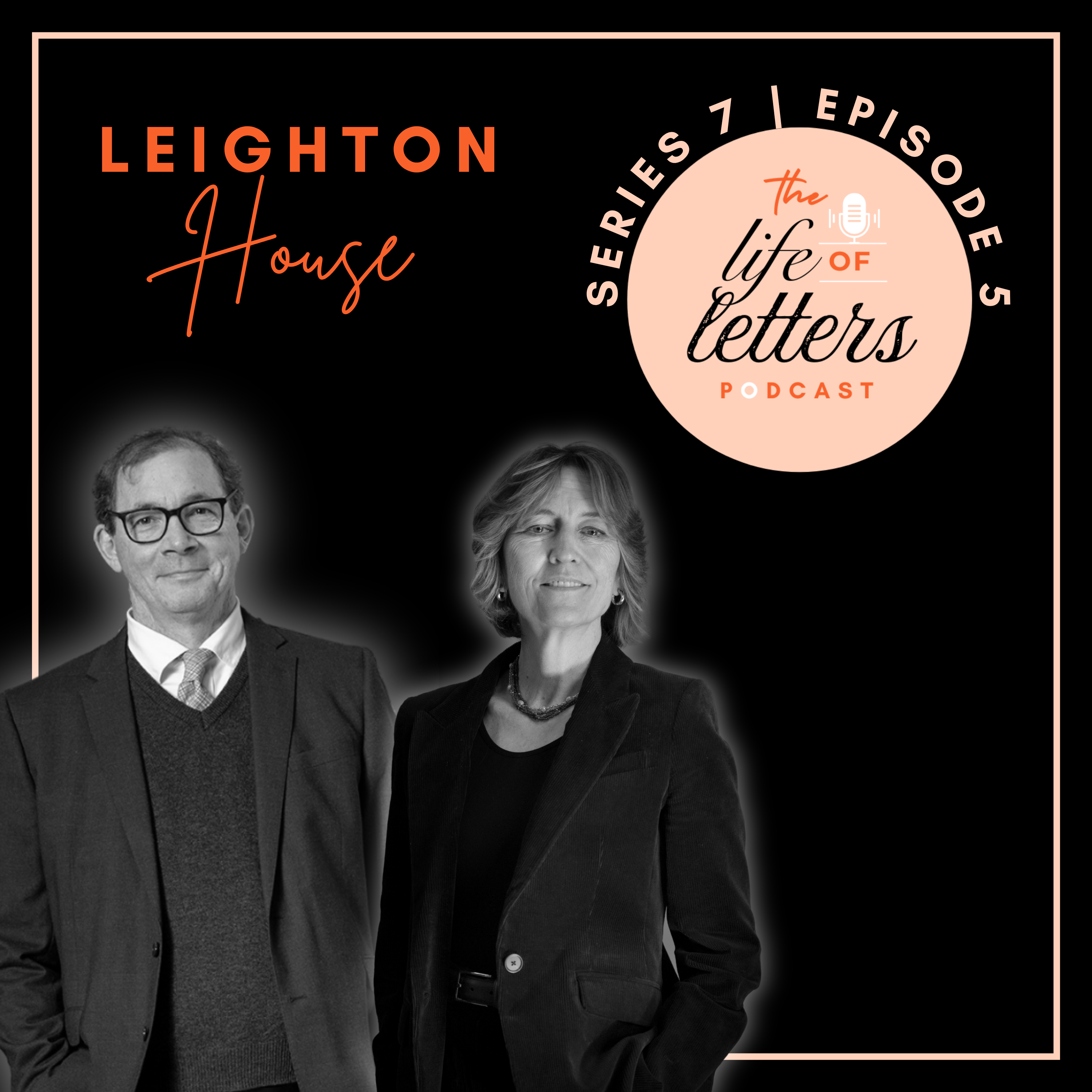
Today I'm delighted to be talking to not one, but two guests all about the incredible Leighton House in London.
Firstly, Dr. Melanie Gibson, who is a well known authority on Middle Eastern ceramics, writing and lecturing on them worldwide. She is also a trustee of the Friends of Leighton House, where she first became fascinated by the history behind the creation of the Arab hall, which we will come onto very soon. And secondly, Daniel Robbins, the senior curator of Leighton House Museum and Sanborn House as well, so two of London's most significant house museums. And Daniel is also responsible for, for the award winning project to restore the historic interiors of Leighton House. So a huge welcome to both of you, Daniel and Melanie.
[00:01:32] Speaker B: Thank you, Dora.
[00:01:34] Speaker A: So it's lovely to have you here. And Daniel, I wondered if we could start with you and can you just sort of set the scene for those of us or those listening who may not have ever been to Leighton House or may not have even heard of Leighton House? Can you tell us a little bit of a brief history where it is? What, what is Leighton House?
[00:01:52] Speaker B: Well, so Leighton House is the extraordinary studio house built by the painter Frederick Leighton.
It sits in quite an unassuming street, Holland Park Road in Kensington, just off Kensington High Street.
And it really came to embody the idea of what a great artist was in the late Victorian period.
So Leighton started to build it in the 1860s when he was in his mid-30s, and it really became a project that preoccupied him pretty much for the rest of his life. So over the 30 years that he was living in the house, there was really no period of any length when he wasn't either planning some extension or embellishment of it or executing that, that embellishment. So at the time of his death in 1896, he had just been ennobled as Lord Leighton and remains the only British artist to have received that honor.
And he'd been the president of the Royal Academy for the previous 18 years and was Sort of universally well regarded as doing so much to enhance the reputation of art and artists in this period.
And very much the house that he had created was seen as part of that legacy.
And immediately after he died, there was a lot of debate as to what should happen to it, with the immediate idea that together with all of its contents, it should be preserved for the nation.
That didn't quite happen because for complex reasons, the contents were sold before really, that campaign to preserve it all gained momentum.
So while the house was preserved, it did lose its original contents.
[00:03:51] Speaker A: Gosh, what a cliffhanger you've left us on. So then, then I presume at some point it. It sort of all comes back together and there's a lovely. Well, it goes to
[00:04:01] Speaker B: a very. A very rocky period through the first part of the 20th century when, when all things Victorian fell so.
So far out of fashion. And it's really from the 1980s that gradually it's been restored and we've been able to reacquire some of the original content. So it's probably now closer to how it was in Leighton's time than almost any period, any period since.
Since his time.
[00:04:34] Speaker A: Amazing. What an incredible kind of life and journey for an artist at that time. But I wondered, Melanie, can you zoom us in on a particular area within the house, which is the Arab Hall? And what I'm gathering from Daniel as well is that this, although he's an artist and works in amazing ways and produces pieces of art, the house itself is almost a work of art,
[00:04:59] Speaker C: just as important, actually, and was described as such. His biographer, Mrs. Emily Barrington, says his house was really.
He should be as well regarded, as famous for his house as he is for everything else, but it's part of his body of work.
But let me take you into the Arab hall, because this was one of the incredible additions that he made to the house and he.
Some time after starting the house, he and his. An important figure in this is his architect, George H. Son, who's very much his collaborator in his project and collaborates on every single addition and extension to the house all through his life.
So he decides that what he wants is an extension which is going to incorporate a lot of the tiles and other objects that he's been buying on his trips across the Middle East.
So you walk into the reception area of the house and it's quite humble looking, not particularly. And then you. From there you go into these rooms and that takes you into this suite of three rooms, the staircase and adjoining hall, and then the Arab hall and two of these rooms have got the most glamorous, gorgeous turquoise tiles. And they. You end up in the Arab hall where you have a fountain in the middle, a golden dome above windows on two sides which have these screens of pierced wooden screens which are typical of Arab houses where they, you know, they stop the sun from coming in, but they allowed the air in in London. They've obviously got glass behind them in London which they wouldn't have in Cairo.
And all over the walls are these sensational tiles that Leighton collected on his journeys to Egypt and to Syria particularly. And then above that, a golden frieze which was designed by someone called Walter Crane. I mean, the whole thing is I've never known anyone not walk into the space and just literally be open mouthed by it and go, wow. And that's the same when it was completed in 1881 for the visitors then as it is all through the years and by some miracle, all through the vicissitudes of the house within the 20th century, when it really did wasn't looking its best, the Arab hall still remained. Nothing could be done to it. You know, the tiles survived. So it through the hundred, whatever we now, we're now it's 150 years since it was first built. It hasn't really much change and it has the same impact on people now as it always did.
[00:07:21] Speaker A: Yeah.
Wow.
And I presume it's a quite an unusual, you know, this wasn't happening all over the world or all over, you know, London. It wasn't something that everyone was like, oh yeah, let's build a house and have a specific room that represents a culture and an art form that maybe we don't otherwise experience in these spaces. So do we know what his motivation behind it was?
[00:07:51] Speaker C: Well, that was.
We've just unfortunately just completed an exhibition called the Arab Hall Past and Present. And that was really to show a little bit of what, what the motivation was and how it came about. And the larger project behind that was a book. So I started writing quite a long time ago because I was so, so curious about what could possibly have been Leighton's motivation. You're absolutely right. There are not Arab halls dotted all over London or indeed all over anywhere. Just there are a few of them. It's not entirely unique, but I mean, I have to say, being partisan, it's the most beautiful one by a mile.
And his motivation was really a series of journeys that he took.
He actually traveled for the first time to algiers in his 20s, but it wasn't until he moved to London when he was in his 30s that he started doing a whole series of journeys, starting in 1866, when he went to southern Spain. And we have to think of southern Spain as being part of the kind of Islamic story, because the Alhambra, Granada was a really romantic building that people that had started being restored at this in the 1860s. And so it was very much in people's imagination. And Leighton was incredibly struck by it and by what he found there and by a whole trip he did in southern Spain. And then over succeeding years, literally over four succeeding years, he went to Spain, then he went to Turkey, then he went to Egypt, then he had a bit of a gap, then he went to Syria, he went to Sicily, and he went back to Spain. And over that whole series of journeys, he was absorbing the culture, the atmosphere, the light, the architecture and the design. I think he was completely became enamored of the extraordinary design and color that he found in buildings. And these would not just have been mosques, but also private houses, you know, rather nice private houses with tiles on the walls and kind of wooden screens and domes and things. But he was seeing a whole series of different kinds of building.
And more than anything, it was just a kind of a feel, because he's. What he builds in the Arab hall is not exactly what he saw in Cairo or Damascus. It's his own interpretation, and that's why he's got British artists who are involved. It's a kind of hybrid, interesting mix of. And I just should say, as an aside, he loved going shopping. So when he traveled, he bought tiles and lots of things.
And that was. Although there was not a lot of information on how he traveled or what he did when he was in the cities.
We do know. We have his bank accounts, and I identified that when he was in Egypt, he withdrew from the bank of Egypt £300. Now, this is in 1868. £300 in 1868 is worth about £30,000 now.
And that's a lot of money. So I thought, well, what was he doing with all this money? Clearly, this must have been a moment in which he felt he was really, you know, he could have had the opportunity to buy. And I think the first huge purchase of tiles was in. In Cairo on that trip.
[00:10:56] Speaker A: Wow.
Wow.
Yeah. What a. What a.
I mean, a brilliant thing to choose, I think.
Look at where it is today. That's. That's really choosing for the future. But I think what strikes me as quite interesting is this idea that you're wanting to bring something home with you, that so many of Us can relate to that. Right. I mean, we don't often then go and build a room in our house about it. But there is this real sort of. You connect to something in another time and place and that you want to treasure.
[00:11:31] Speaker B: There is an element where these artists are conscious about building an environment that is going to put them on the map, effectively, that it's maybe a little cynical to sort of suggest he was only in it for the kind of the payback of the raised awareness of his home. But it is the case, isn't it, Melanie, that the sort of fame of the house grew enormously once he had built it.
[00:12:00] Speaker C: Absolutely. And he was delighted to show people, Ryan, from the very beginning, in fact, I found this wonderful lady called Florence Caddy, who was a kind of.
It was a time of interior decoration. People were able to. There was a whole movement now to. There were shops like Liberty's, were opening up department stores. People had more income and they wanted to beautify their houses. And so this was also shown as a kind of example that, you know, that the whole of Leighton House, the Studio house, was an example of how to do things absolutely beautifully. Because Leighton, apart from anything else, was known as an aesthetic. He was part of something called the aesthetic movement, which is a kind of the cult of beauty, effectively, and he showed it off. But I also. I just want to tell the story because this is one of the things that moved me, incredibly.
It takes four years to make the Arab Hall. It's an enormous project. There's lots of different people involved. It's incredibly expensive.
I think it's worked out that it was. It cost about four times more to make the Arab hall than it did the whole of the initial original house, which had been built, which is an enormous. And that's not counting the tiles and everything else that he bought. We don't know the prices of those.
So this was a huge financial investment.
And at the end of his four years, he's completely delighted and can't wait to show it off. And he was in the. His habit was to give an annual music party, which would normally. Which would happen in the studio. So what better opportunity to show off the newly finished Arapahoe than to have his music party? And so he waits. He delays it a little bit. Normally. It was in the spring, he delayed it until July. And Daniel found this wonderful letter, which is Leighton writing to the Prime Minister's wife, Catherine Gladstone, and saying, Dear Mrs. Gladstone, I'd be so delighted if you and your husband, William Gladstone, would come to a party A music party in my Arab hall. And why this was important was, first of all, the my made me was incredibly touching because I thought he's really, you know, he's showing off something that he's so proud of. But also because it was one of the first times that we knew that it was he who called it the Arab hall because previously in letters he'd refer to it as my Oriental fantasy and things. He'd not actually given it that particular. So we wondered at one point, you know, who called it the Arabell. Did it. Just how did it arrive at this name? So it was a name that he gave it himself. That's how he described it. And it is.
It's also slightly complicated because there are Turkish tiles, there are Syrian tiles, but there are also Persian tiles. So it's not strictly Arab. This is a kind of one of those.
He's decided he's chosen that name. But it's, of course, much wider than that. That's too narrow a definition. But it was easy for him to sort of, you know, it's an easy term and it trips off the tongue. But we do sometimes have to explain that, you know, there is more to it than that.
[00:14:49] Speaker A: And
[00:14:49] Speaker C: this represents also a vision of his.
Of that part of the world, of the kind of these regions that he traveled to. It's not strictly accurate in the here and now. And occasionally people think. People ask that question and say, but those are Persian tiles, you know, or someone will say, these are Turkish tiles. You, you know, they want it to be more narrowly limited
[00:15:08] Speaker A: and
[00:15:08] Speaker C: defined.
[00:15:09] Speaker A: Yeah, yeah. And. And it's taking something out of a context, as you say, from. From history, which is.
Yeah, now we. We understand things in a different way. And I think.
I think we can be. Yeah. Sensitive to. To how we. We would represent it slightly differently. But I think what's really interesting there as well is that there is this sort of multicultural representation within one space, which he saw beauty within all of these tiles and all of these things. But are there different inscriptions? Because there's. There's scripts. Right. As well. It's not just, just. It's not just beautiful artworks that are patterns and maybe sort of geometric shapes and things. There's. I. I presume there's actually some words in there. I wondered. Definitely,
[00:16:02] Speaker C: definitely. We'll get let' to the words.
[00:16:04] Speaker A: That's what we're here for.
[00:16:05] Speaker C: Yes, there are definitely, definitely some beautiful panels of inscription. In fact, on that first purchase of tiles, One of the panels he bought was a really beautiful panel, which he didn't have space for. So there's an engraving that was in a. A trade newspaper called Building News, and it was published in 1876. And it was. I think it had these several engravings of interiors of the house, in which. I think the point was that this was so unusual that that's why they wanted them to be illustrated. And actually, it wasn't me, somebody who also works in the house, who's the head of exhibitions, who's called Hannah Lund, and it was she who spotted that this panel of tiles was in the engraving, but it was tucked under the stairs, where it can't have been very visible, and it was probably in a frame. So Leighton. Probably it was the custom, because people knew that Westerners liked things in frame, so they would frame up nice panels of tiles. So Leighton buys this panel and it says the beginning of every surah of the Quran says, in the name of God, the merciful, the compassionate. It's called Bismillah Rahman al Rahim. And it's really. The letters are in white against the blue background with lots of flowers. It's terribly, terribly pretty. And the proportions are fantastic.
So this panel eventually is going to come out from its kind of little hidden spot and
[00:17:21] Speaker B: upstairs.
[00:17:22] Speaker C: Exactly. And it's going to be then put in a very prominent place inside the Arab Hall. So I think, and Leighton is on record as having said that, he thinks the calligraphy is utterly beautiful, but he can't understand it. He doesn't read it. He was a linguist. I mean, Daniel backed me up. He spoke lots of different European languages and famously.
But he couldn't get. He couldn't get, you know, his way around Arabic. And I have to say, my degree was in Arabic. And I can. I sympathize with him completely. It's a very, very difficult language. But he just liked the proportions and the beauty of it. And so he was happy to have. Now, there are about eight to 10 inscription panels. So these are not one single tile with writing on it. They're made up of different square tiles and fitted together. And the extraordinary talent of the craftsman was that they could make it look as if there was. There was no. You know, it looks as if it flows. The letters flow from one to the other. And the Arabic has an incredibly sort of cursive.
The calligraphers could extend the letters in both directions so they could make them fit spaces. So it's the most perfect kind of writing to combine in different ways. And they don't just have a line, as we do, where you start on the Line and follow to the end of the line.
The words and the different parts of the letters of the words can be put at different levels, which makes it also very, very difficult to read if you're not a specialist in reading inscriptions in Arabic. And so we are one of the things we wanted to do for the future of the house and because this is important, because very many Arabic speaking visitors come to the house and they couldn't necessarily always read the inscriptions. So we have a wonderful Saidi scholar read all the inscriptions, translated them and put them into their context. And that's all in the back of the book. And that will also now be in the house, available for anybody who comes to visit. So you can now read the inscriptions properly. And some of them are Quranic, but some of them are wonderful. They say things like welcome to my house and enjoy my hospitality. And they're sort of, they're saying, come, you know, come into the house. In which I hope that Frederick Leighton knew that's what they were, I'm sure.
[00:19:42] Speaker B: Yeah,
[00:19:44] Speaker A: yeah, that's really interesting because there's two things happening, isn't there? There's his love of what it looks like visually as an art form and then there's the deeper meaning behind it. And as you say, some he wouldn't have known what they meant, but some he. That it suggests there's an intention to say whoever he had commissioned create these tiles or they were already in existence.
[00:20:11] Speaker C: They were already, they were already in existence. He was buying historic tiles. Most of them date to the 16th, 17th century. Some of them are probably restored in the 19th century. So he was traveling and he bought a lot of the inscription tiles in Syria.
Most of them, apart from the Sinishorn he bought in Cairo. He probably bought the rest of them in Damascus. And in Damascus they probably, they had, I'm actually certain people who could restore that. Some, you know, if you imagine a 200 year old panel of tiles, it might be missing sections. So they would have had sections restored. Although Leighton complained in one letter in which he said, I'm buying all these panels of tiles, but there's so many missing ones. And he was kind of frustrated he couldn't buy as many as you wanted that were in intact condition.
[00:20:54] Speaker A: It's like collector's item, isn't it? You want to piece the whole collection together.
[00:20:58] Speaker B: But it was one of Melanie's amazing discoveries, is that where tiles were missing, they.
The potter William de Morgan was commissioned to fill the gaps. And there was always, in the Arab Hall, a very good example where there's two parrots perched on a fountain. The left hand parrot is clearly a William de Morgan parrot, and the right hand one is the original. And we'd always just assumed that the left hand parrot had been lost and damaged and disappeared. And Melanie tracked the parrot to the Louvre in Paris. So our left hand parrot is in the Louvre, which is an amazing discovery
[00:21:41] Speaker C: because you have to imagine that although Frederick Laken was busy, you know, wanting to buy things, so were many, many others. There were all these individuals. And I found an American called Frederic Church who built a house in the US and it's called Alana, and he built that with tiles from Damascus. But there were lots of individuals and there was also. I think it's worth mentioning that what we know is the Victoria and Albert Museum at the time was known as the South Kenton Museum. And this was a museum of design where people were being sent out, agents were being recruited to go and find perfect examples of design for the museum. And so there were all sorts of individuals at their buying. And the one that ends up in the Louvre was a French collector and it was in his own personal collection and ultimately he bequeathed it to the Louvre. So it was just, it was, you know, one of those lucky, lucky moments that, you know, you come and I had several of these. It was, it was the most pleasurable bit of research I've ever done because, well, Daniel, I used to go into the house every two or three months and say to Daniel, now let's have a cup of coffee. And I'd sit down and he'd think he was going to get away with a 10 minute chat. And it would be at least an hour before I'd finished telling him all my new discoveries, all the things that had come together.
[00:23:01] Speaker B: Because that was really one of the things, wasn't it, is that the Arap hall, although the best known space at the museum, was oddly little researched and understood. So it was just so wonderful that Melanie came and filled all these
[00:23:16] Speaker A: missing gaps.
Yeah, a detective turned up. Yeah.
[00:23:20] Speaker C: Well, I have to say, I mean, it's a great pleasure doing what I love doing what I do. But this was the most amazing project because it kept on giving. I kept on. The more I scratched around, the more I continue and I, I had to be very inventive in, in my sources of research because as Daniel said, there is, there just wasn't this great archival, you know, there weren't masses of masses of archives for me to go and explore.
[00:23:45] Speaker A: If you've been enjoying the life of letters, I'd Love it. If you'd hit subscribe wherever you're listening today. It's a simple way to support the podcast and make sure you never miss a new episode. And if you know a fellow letter lover, why not share it with them, too?
Now, let's get back to the episode.
[00:24:04] Speaker C: I had this one sentence, which Leighton wrote to a biographer, in which he described where he'd been. So they. It was known that he traveled to the various countries in the Middle East. And in that sense, he was unusual because you had to be brave, you had to be quite wealthy to organize all of these things. There wasn't a kind of structure. You know, Thomas Cook hadn't started his, you know, his journeys, which did happen, but not for another few years. So he. He was going on his own mostly, and he.
And I was thinking, well, what did he do in these places? How do I find out what he did in these places? And I. I realized that I could start to look at black and white photography, archival photography, because this was the time when really photography was getting off the ground. People were getting excited about it and were beginning to do it, and they were. There were photographs of Cairo and Istanbul and Damascus. So I started looking at these photographs and trying to imagine Leighton as he traveled through these cities. And then I started looking at guidebooks, and there I could find out what the hotels that Europeans stayed in or what the itineraries were. And that way, I kind of literally traveled in his footsteps. And the more I did that, the more I saw details in some of these buildings that I thought, gosh, that reminds me of the Arab Hall. I wonder if that's what he saw. I wonder if he had a photograph. I wonder if he did a sketch.
Did he just retain it in his mind? Did he then discuss it with his architect? So I was kind of just endlessly visualizing the process by which these men kind of collaborated on creating this space.
And the more I dug, the better, you know, the more I found. Really,
[00:25:38] Speaker B: the great missing thing is that we know that his architect, at one point, in a letter to somebody else, said that he had hundreds of letters from Leyton.
And presumably those letters documented the process and the decisions they made and options they chose.
So in that. In the absence of that, as Melanie is saying, it was necessary to try and find and piece together the story of the realization.
[00:26:09] Speaker A: Yes.
So it's sort of shrouded in mystery, although Melanie's doing a great job of uncovering all of these wonderful things and piecing together the journey. But from what I understand, as well. Frederick Leighton himself was a pretty mysterious man. And I wondered, Daniel, whether you could give us a little bit of an idea about what we do know about him as a person.
[00:26:31] Speaker B: Well, he kind of was and he wasn't. So this was a sort of generation of artists, with Leighton very much at the forefront, where the artist becomes a celebrity, that there's great interest in them and the work that they're going to produce, and great anticipation of the Royal Academy Spring Exhibition.
And so, both from a social point of view and from a financial point of view, it's a very good moment to be an artist, because London is expanding so rapidly. There's so many grand houses being built with lots of empty wall space that people are looking to fill.
So, as a public figure, particularly from when he became the president of the Royal Academy, I mean, everyone knows who he is, and he's regarded as a great figurehead for art and for artists, and seems to have all of the requirements to discharge that role. So he's very.
He's very diplomatic, he speaks five languages, he's friends with members of the Royal family.
He.
There's lots of accounts of when he's hosting these grand Royal Academy events, dinners and the opening of the exhibition.
[00:27:57] Speaker C: In fact. Sorry, The Prince and Princess of Wales were both also invited with Mr. And Mrs. Gladstone. They were also.
[00:28:02] Speaker B: Oh, yes, yes.
Writing to the Prime Minister saying, would you come next week? The Prince of Wales is, you know, popping up,
[00:28:11] Speaker A: by the way. Yeah,
[00:28:12] Speaker C: exactly.
[00:28:13] Speaker B: It's sort of that, so.
And yes. So all of that sort of. Socially, he was seen as kind of the ideal artist. And I think Leighton himself had in mind to kind of try and change the profile and the reputation, the prestige of art and artists in this country, and really set about doing that in a deliberate way.
So there's that public side, but his private self is a much more difficult idea to kind of really get hold of. And even after he died, in obituaries and so on, people said things like, I knew him for 30 years, but I don't think I ever really knew him.
And there's a great separation out of his private life and that public role. And I think part of his traveling was that he really invested himself in the periods he was in London, working in his studio, but juggling all kinds of calls on his time. And he's endlessly being invited to everything, and he's consulted by the National Gallery and all the museums, really, about when they're thinking of buying a painting, they ask him what he thinks about it. So there's enormous demands on his time. And I think the antidote was then to travel and have time where it's entirely
[00:29:53] Speaker C: up
[00:29:53] Speaker B: to him as to what he does and where he goes and.
And he can sort of make.
Prioritize whatever he wants to do, rather than even being part of a group of friends where you might have to compromise and go along with what others want.
And so the sort of absolute.
The example that really captures this is when he died here at Leighton House in its single bedroom, which is one of the great oddities of it is it only has a very modest bedroom.
His last words, which then are repeated endlessly in all the obituaries that appear after his death, was he said, give my love to the Academy, to the Royal Academy, which is what you would think he would say about his devotion to that institution and to art.
But then the doctor who was looking after him gave an account where he then turned to his two sisters, Alexandra and Augusta, and spoke to them. They had a conversation in German so entirely to keep the content of that confidential between them.
And so again, that separation of public and private means that in many ways Leighton is a sort of mysterious, unknowable kind of figure. And those that didn't like him or met. I mean, usually people referred to him in glowing terms of his great.
How hard he worked, of his commitment to the Royal Academy, of his charm, of all those things.
But the word that's used is there was something artificial about him that people felt. There was always a performance going on and you couldn't really get behind that to kind of feel that his guard was down and you really were engaging with him in a kind of more personal, intimate way. So he's a fascinating but tricky character to feel.
You really know.
[00:32:06] Speaker A: Yeah.
[00:32:07] Speaker C: And I think the Arab hall and that side of him belongs to the younger side of him because he completed it or he was in the process of it before becoming the president. And I think his life becomes more formal and more serious and more devoted to the.
To the arts subsequently. So I think those 10 years of travel and that was more his carefree younger self. And then he turns into something much more public and institutional.
[00:32:34] Speaker B: Yeah. And I think as the president, he felt he had to sort of be.
Steer a kind of neutral course and not get too friendly with one group of artists as against another. And so he sort of developed this more remote
[00:32:50] Speaker C: Persona. Yes.
[00:32:52] Speaker A: He reminds me of a sort of modern day influencer where I feel like what's presented is may not. I mean, this is probably really insulting to lots of influencers. But I imagine it's that the performative side of what you show to people versus what's behind the scenes and, and. And that real contrast of separating and the same with, I guess, other celebrities these days and. And trying to find that balance between, actually, I don't really want people in my private life and knowing who I am behind closed, closed doors. And particularly probably for artists who have a lot of processing and creative ideas and thoughts and feelings that you may not feel that other people understand and all the things that do go on for any human being. But I guess when you are thrust into maybe the limelight and your.
Your house is now becoming a space that is no longer private because you are inviting more and more people in and more and more people are talking about it, and it's becoming this point of focus. I think it's fascinating that his bedroom. I mean, it's fascinating in a, you know, reinforcing way that his bedroom is small and the house around him is the public space.
And it just reflects that same thing.
[00:34:11] Speaker B: Well, think his bedroom is kind of off stage and that when
[00:34:15] Speaker A: you
[00:34:15] Speaker B: cross the threshold into the public parts of the house, again, it's the suggestion of a kind of performance taking place which he was entirely equipped to deliver a sparkling performance as
[00:34:30] Speaker A: the
[00:34:30] Speaker B: greatest artist.
And the Arab hall then becomes an absolute in that sense, a stage in which extends a kind of understanding of him and the breadth of his interests and the degree to which he's traveled.
It's all kind of there,
[00:34:49] Speaker C: but it's balanced out also by. There's a couple of wonderful spaces in the house where he could just sit and be quiet. So if you're above the Arab hall, there's a projecting balcony which, as you go up the stairs, you'll see it in front of you. And that's got the wooden screens all around it. So you only dimly note the gold dome and the tiles that are below you. But you can hear the fountain. And it's got cushions in it. And he'd have been able to sit there quietly and just appreciate the sound of the water and see the glint of the gold. And similarly, downstairs, at the bottom of the stairs, there's a. He created a divan out of an inlaid piece of wood that he brought back from Egypt, possibly or Syria. And there he.
He made it full of cushions. He made. A London furniture maker made the sides of it. And so to turn it into a divan. And he. And it's full of cushions. And he could just sit there and look at These gorgeous tiles that he bought back from Cairo, which were all blues and turquoises and flowers, vases of carnation and other flowers. I think that space always to me is again, very touching because we don't normally have seats at the bottom of stairs. This is a very specific place that he's. That he's made for himself. And it's kind of his. His personal appreciation. So he spent a huge amount of time and effort in creating this space.
We now we have a wonderful peacock which rests on one side of it, as he did. And on the other there's a. There's a Turkish ewer, metal ewer. But it's a. It's a really.
One tends to just walk. You know, one's going upstairs and so you don't. But this was a place where he stopped and contemplated. And that always sort of strikes me as well that it's an interesting thing. It's a kind of unusual thing for him to have done.
[00:36:27] Speaker A: I love it. I think we should have more seats at the bottom of stairs. I think maybe we're missing a trick there.
Daniel, Just briefly before that, I kind of bring things to a close that the connection. Is there a connection to Sanborn House? I know we talk about the two museums. Obviously they're both in. In Kensington, but. But they're quite. They're next door to each other. No,
[00:36:47] Speaker B: they're very, very close. So Kensington at this period was really a fashionable. Had become a fashionable suburb.
And so one of the very distinctive things about Leighton House is it's surrounded by a group of other purpose built studio houses that kind of in the wake of it were developed and built by other artists.
And so at its peak there were 11 within about 300 yards of each other.
[00:37:14] Speaker A: Wow.
[00:37:14] Speaker B: So it was a kind of unique enclave of very established, successful artists building these grand houses. Wood Leighton's being the most remarkable of them.
And then the Sanborns. So Lyndley Sanborn was an illustrator and cartoonist, lived, it's about seven minutes walk away on the Phillimore estate in a much more conventional Victorian terraced house.
But they then, as an aspiring artist, tried to develop the interiors of it and present the interiors of it in a conspicuously kind of artistic way and to live in a more modest version of these grand artists in their studio houses. So the two make a very intriguing pair. They're Leighton and Sanborns, were neighbors for 20 years. And there is an account in Sanborn's diary of him coming to have dinner here at Leighton House with Leighton, which his only comment is food. So. So which
[00:38:26] Speaker A: sounds like a. Sounds like a review on Google, doesn't it? Yeah.
[00:38:31] Speaker B: Nothing about the house or conversation or anything else. Just.
[00:38:37] Speaker A: This is probably more of a question to both of you, and I don't know if you come at it from different angles, but the mission and the vision and the future for Leighton House. Now, what are you kind of thinking? Obviously, the preservation remains, but all the wonderful work that's happening, whether it's exhibitions and education and the books that you're writing. Melanie, what do you see for the future of Leighton House? I guess.
[00:39:03] Speaker B: Well, what's been so wonderful for us is this is the hundredth year of Leydenhouse as a public museum, and we've literally never had more visitors. And the project that was over the summer, exploring and celebrating Yara Paul absolutely contributed to that and drew a more diverse, younger audience to engage with it. And I think that Melie and I were talking about it is that that's what really sets Leyton House apart. Instead of just being the home of a Victorian artist, there is this extraordinary element within it that people relate to and identify with in all kinds of different ways. And we produced a podcast or little recordings, really, people from diverse backgrounds in the region talking about what it meant, what the Arapah means to them and how did they discover it.
And that was fascinating and moving conversations about that sense of finding something which is so reminiscent of their heritage. And again, the very specific nature of the are called being, as we were discussing, a great kind of coming together of influence and identity in some way allows.
Allows people to consider themselves in relation to it and their own identity. And that's very much part of the film that was commissioned when the Tiles Spoke by the director Sudhad Khadan, in which the journey of the tiles is used as a way of exploring people's own journeys and their own identity and the formation of identity.
So I think it's that. That is where Leighton House really can contribute something very, very special, I think, and unique as a whole, in which everybody, as we were saying, as the inscriptions denote where everybody can feel welcome.
[00:41:19] Speaker A: It's lovely, isn't it?
[00:41:22] Speaker C: I agree with absolutely everything Daniel just said. I also would like to spotlight a little bit more all of those fantastic individuals. There are so many individuals that we know the names of the ones, obviously George Achison, who perhaps hadn't had all the credit he would.
He should have had as the collaborator, and someone who went on to teach in London and who taught on Islamic architecture and was very invested, maybe hadn't traveled as widely as Leighton, but he was very invested in the principles and the techniques and the technical aspects of the architecture. So I wanted, I think he needs to come back into the picture a bit more. William de Morgan is extremely revered and well loved artist, but this collaboration and how, how everything he ever did for the rest of his life in terms of his creativity seems to have kind of been rooted in his experience as a very young man doing this extraordinary work in the Arab Hall.
And then there's a lot more, there are a lot more individuals who sort of somehow been, you know, their names have been a bit forgotten. And I think it's really interesting to talk about this period of people who, at the moment when the design of the architecture art of the Middle east was, was absolutely in the foreground and it was something that people, people, it was inspirational for everybody from William Morris to very many creatives, you know, whether they were architects, whether they were designers, whatever they were, this was a really key aspect of their, of their practice and their design. And the Arab world kind of encapsulates all that, encapsulates that this moment. But I think there's, there's yet more to be said and I will find a way to say it
[00:42:58] Speaker A: and that, that is the future, isn't it, that this, it doesn't end here. What a beautiful thing because, you know, Leighton has passed on such a huge legacy and such an amazing gift to not just Kensington, but for people all over the world coming to learn about what life was like, what an artist's, you know, world was like, what.
How the kind of connection connecting parts of different cultures can be bringing people together. And I think that's something that is hugely well loved about London in particular. Having its diversity and having this really sort of welcoming spaces, but also art and museums and heritage and the preservation of all of these things being those opening opportunities to bring people into these places together and share across different, different lenses and cultures and languages. It's, it's, it's wonderful knowing more about these things and, and seeing the work that you both are doing is incredible. Where we're going to put lots of lovely links and resources to all of these things at the end. But I'm going to bring things to a close with a very difficult question for you both. This series, we're ending episodes by asking the question, what letter of the Alphabet do you feel holds the most magic or mystery? And why, of course, many, many languages. And Melanie, you probably have several different scripts in minds and different sort of shapes and things going on. But do feel free to share yours.
[00:44:34] Speaker C: Well, I thought about this and I'm going to choose the letter L.
Now, the letter L in Western languages faces to the right and it's just. It's got. It's got an angle, but if it's written in Arabic, it's not dissimilar. It's actually one of the letters that you can. You just have to flip it to the other side so it faces to the left instead, and you have to give it a fantastic curve.
And it's. It's both in the, in the article al, everything is al, which means the. And it's the second letter and that. And it's with a straight line and then the. The L next to it. But also it's a letter that features a lot in the word for tulip, which is lale.
So it has two Ls in it and there are lots and lots of tulips in the tiles of the Aeropol. The tulip is native to Turkey and it's very, very beloved in Turkey and it features enormously in Turkish ceramics. So for all of these reasons, I'm going to choose the letter L.
[00:45:31] Speaker A: Wonderful. Thank you, Melanie. Daniel, can you trump that?
[00:45:39] Speaker B: I have a much simpler and less compelling case to make simply for the letter O.
In that I just enjoy its simplicity of its universal form.
And that's it.
[00:46:02] Speaker A: And that is just a good reason. It is, It's. It holds its own magic, I think. Yeah. You're not alone in the fact that O's have this wonderful.
Yeah. Endlessness, avoid. And all of these beautiful things that. That come out of this shape.
It's. It's so lovely. I always think this question brings up a lot of kind of, oh, I never really thought about this, but
[00:46:25] Speaker B: you're right.
[00:46:28] Speaker A: But here you go, Here you go. You've got your favourite letters. Thank you so much to both of you. But to find out, for anybody listening, find out more about Layton House, they can visit rbkc.gov.uk museums forward/layton-house.
That's a nice mouthful. So I will make sure that that's in the notes. And also people can follow the journey. The. The future of Leighton House at Leighton Sanborn Museum. So they are their sister houses on Instagram. And as always, again, we'll put notes on and links. You mentioned a beautiful film, so we're going to put the link to the YouTube when the tile spoke. Is that right? Yeah. And Melanie, the book, is it the Arab Hall?
[00:47:11] Speaker C: It's called the Arab Frederic Leighton traveler and collector.
[00:47:14] Speaker A: Yeah, beautiful. Amazing. And people can get a really deep dive into all of this and explore these amazing worlds of Leighton's, who's left us with a beautiful episode, but also lovely conversations that that future generations get to explore. So thank you both so much for being here. Melanie Daniel, thank you, thank
[00:47:35] Speaker C: you. Thank you very much
[00:47:36] Speaker B: for
[00:47:36] Speaker A: being a part of this. Thank you.
Thanks for listening.
Series 7 is made possible by my wonderful producer, Heidi Cullip, and the support of Speedball Arts.
If you've enjoyed the episode, don't forget to subscribe, leave a review or share it it with a fellow letter lover.
Say hi over on Instagram and watch clips and moments for all the series on YouTube at the Life of Letters podcast.
And until next time, keep listening, keep creating, and keep celebrating the life of Letters.