Episode Transcript
[00:00:02] Speaker A: Welcome to series five of the Life of Letters, a podcast exploring the art history and future of calligraphy, handwriting and all things letter related.
I'm your host, Laura Edrilyn, a London based calligrapher with a curious mind. Continuing this journey to connect with artists, historians, experts and letter lovers all around the world.
As the podcast grows, I'm so grateful that this season is once again kindly supported by speedball art, champions of craftsmanship and creativity, helping keep the life of letters thriving across generations.
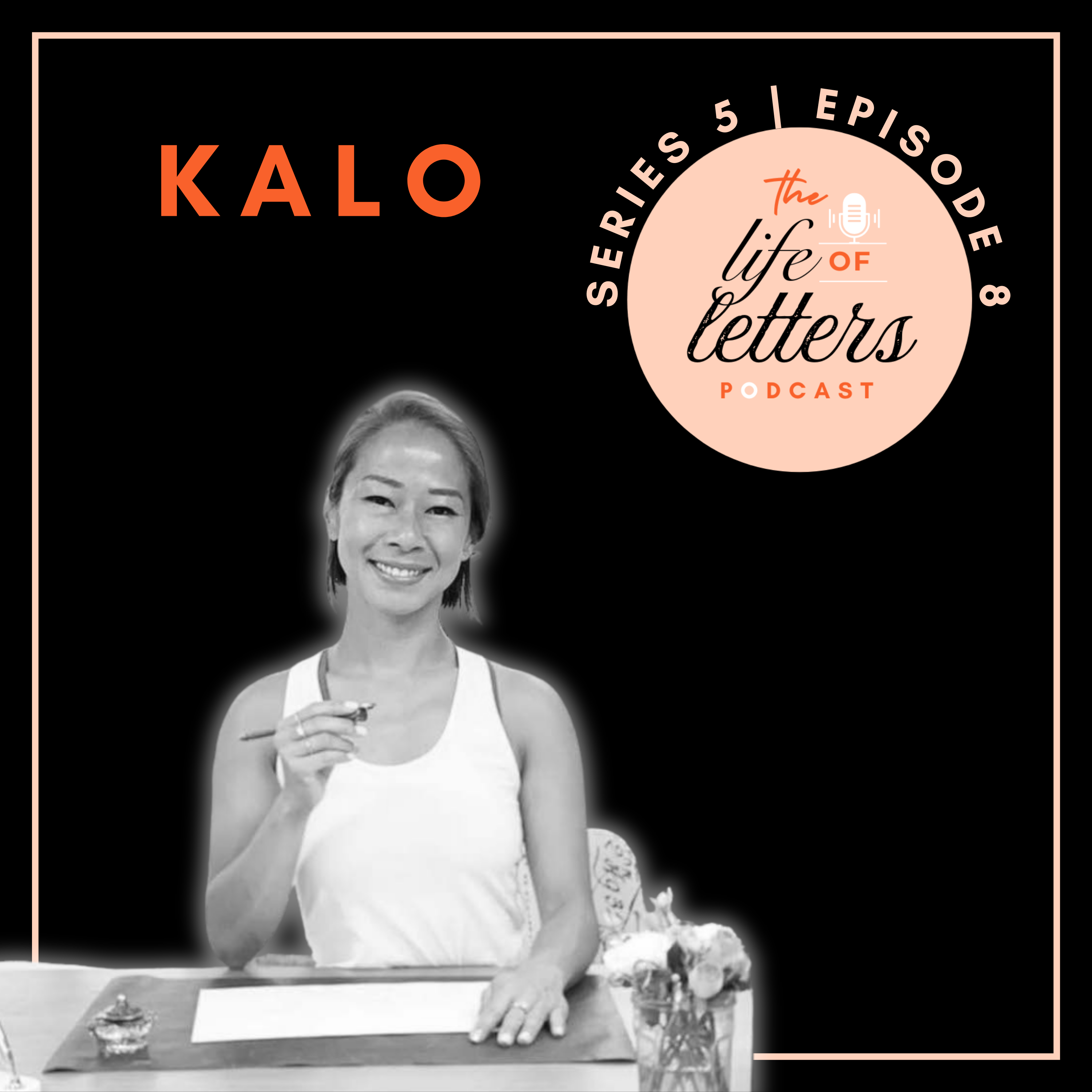
[00:00:39] Speaker B: Today I'm speaking with Carlo, a calligraphy instructor and script tattoo artist based in Hong Kong. Kahlo specializes in engrosser script, Spencerian and medieval illuminated manuscript paintings. And since founding Carlo make art in 2015, she has nurtured a calligraphy community through her studio, hosting workshops for over 6,000 students, including teaching at IM Perth, which is the international association of master penman Engrossers and teachers of handwriting and New York Society of Scribes. A huge welcome to the Life of letters. Carl.
[00:01:17] Speaker C: Hi, Laura. Thanks for having me.
[00:01:19] Speaker B: It's so good to have you here. And your bio just is exploding with kind of activity and all sorts of things that you do. You do literally everything. And I've been on your website, you have a shop, you run classes and horses and you do bottle painting and leather painting and engraving and you tattoo beautiful scripts onto people.
And I just think it's an amazing, diverse business that you have and you've incorporated script into all these different elements. But I wanted to start with where calligraphy began for you.
[00:01:54] Speaker C: Sure. I mean, like it really traced back to when I was a kid because my father is, as a hobby, he's a Chinese calligrapher and painter. So when I was young, I always see him, you know, like doing Chinese calligraphy and painting. I can smell the ink in the house, you know. So when I was young, he played a big influence in my artistic journey. And I remember when I was writing my homework and if he didn't like the writing, he would erase everything and then I have to rewrite it to make it nice. And I remember like feeling very upset about it. But I now understand because this is how I was kind of trained to, you know, try to keep my writing tidy, you know, so that's it. Childhood interest. But I didn't really. Well, I actually did it in high school. When I was a teenager, we have this penmanship competition and I was very competitive. Yeah. So every year I want to be the champion. And I think, you know, because that's. Well, not because of the title, but it just gave me an identity. I felt like as a teenager, you know, like that's something that I am good at. Yeah. And actually, it didn't really. I didn't really continue until 2011 when I turned 30 years old and I started Carlo Migart. I started as an invitation designer, actually was doing a lot of wedding invitations, and I had clients asking, hey, can you also do calligraphy? You know, and at that time, I didn't look into it because I was so busy starting up an invitation business.
And then just really randomly one day I was walking in a bookstore. This is in Singapore, actually. I was living in Singapore at that time. And I came across a calligraphy book, bought some simple tools and start, you know, like, practicing. And that's kind of how I started in 2012. Then. I want to keep this short, but someone asked me to teach. I think it's very similar to Nina's experience because I listened to her, you know, interview with you. Someone asked me to teach. And I thought, actually, at that time, I didn't really feel confident at all because I feel like a teacher has such big responsibility.
But this lady runs. She runs a florist. And she asked me so many times, and I thought, well, if someone was so confident in my teaching and I should feel more confident in it. So I start teaching classes in her florist. And it just went kind of viral because no one was teaching pointer pen back then in Singapore. 2015, I went back to Hong Kong. Moved back to Hong Kong, and I started my Kalomic Art Studio and just fully focused on teaching calligraphy. Yeah. And so that's kind of the journey how, you know, like how I started. And I didn't start it because I want to be a teacher, but I really enjoy sharing. I just love sharing. Even when I'm not teaching. I'm, like, trying to tell my friends about calligraphy. You know, like writing in front of them, things like that.
[00:04:48] Speaker B: Yeah, yeah, I love that. Yeah. Inspiring more people to understand more about what it is as well. And I think, yeah, that's a huge mission for the teachers. And when you're passionate about sharing, that makes an even better teacher. Right?
[00:05:04] Speaker C: Yeah.
[00:05:05] Speaker B: And then, so at what point did the tattooing with scripts kind of come about? Is that a later part of the business?
[00:05:15] Speaker C: Yeah, definitely. So When I started 2015, my own studio, it was really like, there's such a demand of students who wants to learn. So the business was going really well for, you know, three, four years. And then because Hong Kong, I don't know if you knew we had, in 2009, we have a political, you know, like, social movement in Hong Kong. A lot of tear gas flying around, even downstairs my studio. So I lost a lot of students because people were worried about the safety.
And then 2020, we have the COVID you know, and in Hong Kong, we actually suffer for a long time because we had almost three and a half years of like, you know, having all these social distancing. We can't have like more than four people gathering. You know, we, we, we have to obey certain rules. So that really my business model, like in terms of having a lot of in person classes and I start teaching online. Back then during COVID and then what happened was 2002, two and a half years ago, I start to worry. I'm like, oh, what if my class is just really not going well? You know, I'm struggling to find students and I have to keep canceling classes, which I really love and enjoy, but I need to have an income, you know, after all, we still need to make some money for a living. And then I keep thinking, what should I do? And, and like my husband said, oh, why don't you do a full time teaching? But because I've been freelancing in a way for so long, you know, over 10 years, and I don't really want to have a 9 to 5 job. And I thought of tattoo because when I got my tattoo around that time, you know, two, two and a half years ago, my first tattoo, and I remember watching the tattoo artist doing what she was doing because I was like, oh, I know exactly what she's doing. And it just connected. Like when I was thinking what I should do for a new, like a side business or something. So I thought of tattoo and I actually went back to her who tattooed me. My, my teacher. Well, she was my teacher. And then I said, can you teach me? And she said yes. So I start learning from her. Yeah. And, and then, you know, she taught me like some basic skills.
[00:07:25] Speaker B: Actually.
[00:07:26] Speaker C: I'm still very kind of. I would say tattoo is like calligraphy. There's so much to learn. So many different techniques, so many styles, so many different type of machines, you know, and needles, like our nibs are all different.
Anyway, I'm still learning, but I'm now doing tattoo in my own studio without my mentor guidance. I'm kind of on my own now. But I love the challenge because you cannot make mistake. Anything else you do calligraphy, you can make mistake, right? But it's on human skin, so the pressure is high. But I love. I'm a person who love challenges. I like to take on things that, oh, my God, can I do it? But it's quite exciting. Get me very excited. Like, I get the hype from, you know, taking challenging projects. Yeah. So, yeah, that's how it came along. Yeah, that's how it came along. And obviously, I'm a calligrapher, you know, so I want to specialize in script tattoo. I can do drawings as well, but I just don't want to. I want to specialize in script. So there's something special about this tattoo service that I offer.
[00:08:29] Speaker B: I love that I haven't got a huge amount of knowledge in this area, but I think what I would normally see is, you know, you have a calligrapher or a designer who will create the artwork or the words or the design of the letters, and then a tattooist or tattoo artist would then recreate that. And what you've got is this dual skill here where people can go in, have exactly what they want designed by you and then tattooed by you onto them. And that's really special, really unique experience because you're bringing these two art forms together, and I think that's. That's incredible. Have you got a favorite one that you've done?
[00:09:10] Speaker C: I thought about this. So actually, all the tattoos I've been doing so far are so personal because it's script, and usually, you know, it could be a name. It could be something that really meaningful to the. To my clients. And there was this lady. She actually. It's a big tattoo on her calf, kind of around her whole calf. And it was using brush calligraphy to write her name. And the story was very moving because I was like, oh, why would you like to write your name? Because I want to understand reason. And she wanted to be so big. I sent you, you know, the photo. It's like brush, click, V. Very, very.
It took me eight hours to do it that day without. With one break. Yeah. And she was very patient, actually. And the story was because her name. Her name is Jaggy Mae. And when her mom was trying to get preg, her mom wasn't able to get pregnant for a while. And someone told her, why don't you try jogging? And so her mom start jogging just for, like, two weeks or something, very short time. And her mom got pregnant with her. And the mom. Her mom thought, okay, whatever, whoever came out from her belly, I'm gonna name him or her Jaggy. Right? So it's like jogging. There's a name, a meaning to It. And then May. It's M A E. But she was born in May, as in, you know, the month. And then. So her name is Jackie Mae. And I said, but why do you want it to be on your lake? You know? She said, because the whole life she's been looking after her family, and she always prioritized them. So the lake represent the bottom. Like, she always put herself last, but also represent the strength and the power she has because she used to do karate. So it's all kind of come along, like, very nice story. And she wanted to be bold and to represent her strength. And sadly, I remember she told me that because all her family, like, close family, not around anymore, like, you know, they. They passed away. So she decided to do that tattoo in honor for. For the parents, you know, so that was really meaningful and.
Yeah.
[00:11:11] Speaker B: Wow. And I bet there's just. I mean, when it comes to tattoos, it is such a personal story, a personal journey. It's something that you are permanently holding onto or.
Or, you know, all those things that come with the idea of mark making onto a body.
How does the sort of process work then? I. I'm kind of imagining that you design the letters, and do you do that in pencil? Do you do it in brush pen and then check with the client? And then how do you then recreate that? Yeah.
[00:11:47] Speaker C: No. So usually what happens is someone's interested to do a tattoo in script.
First of all, I need to know, you know, what is the words, you know, or what are the sentences, and then the location of it. And then I will ask them to share with me what kind of style of calligraphy they want. So sometimes if they have no idea, I'll provide, you know, what I can offer. I can do broad pen. I can do pointer pen, brush calligraphy. So usually they have this concept for me. Okay, I like brush style. Then I will do a couple of, you know, writings. And then because I need to know the body part as well, because the design has to flow well with the body part. Right. It's not just like a sticker that you stick it on. So, for example, the one that I just mentioned, because it go around her cuff. So I actually invited the ladies to come to my studio so I can measure it. And I actually use, like, a thinner tracing paper to go around her cuff to do some mock up. So I have an idea of how big, you know, things like that. So it's very bespoke and very personal. The process usually is like. Like, maybe like a week before the actual tattoo happens. I Think if you actually talk to most tattoo artists, they don't provide the design, like, way in advance. The reason I asked, I was curious. I was like, oh, why is that? Because they said, well, first of all, sometimes they worry people will take your design and do it elsewhere. You know, especially if maybe a deposit is not left. For me, that's not my biggest concern because, you know, I.
But it's interesting. When I heard that, I was like, oh, it kind of makes sense because when I got my first tattoo, I sent my design to my tattoo, you know, tattoo artist, and she. She didn't finalize the. The whole thing because I want her to add a little bit of her own element to my design. And she only sent it the night before. And I thought, wow, why is it so last minute anyway? So, yeah, the process is always quite close, and sometimes I even get, like, clients just come up to studio and then we'll draft the ideas together. Like, I write various ones, and then she will pick on the spot. He or she will pick on the spot. Things like that. Yeah. And because it's such a What, for me is very personal, especially when they come up with meanings. Because so far, actually, all my tattoos has meanings to it. Like, I've not done anything. Oh, I just like that because I guess at the end it's a word. Right? So any word that you put on your body has some meaning.
[00:14:14] Speaker B: Yeah, yeah, yeah, you're right. And is it always in a language that, you know. Have you done any in different languages?
[00:14:23] Speaker C: Actually, I have done Japanese. I have done Chinese characters. The Japanese one is quite interesting because the gentleman, he came, he had a black belt, and when they get a black belt, then they have the Japanese name on the black belt.
So he sent me the photo of the black belt. So I would use a brush and mimic the writing. And then tattoo on his leg. Yeah. It was another big tattoo I did. It turned out to be very nice. Yeah. And people who read Japanese can tell it was his name.
[00:14:55] Speaker B: Amazing. I love it. Everyone's getting their tattoos on their legs. This is a trend, obviously, you've started. So can you tell us a little bit about the equipment? So you've. You've got your design now, and it's tattoo. Tattoo making day, and they're obviously there for however long it will take you. And I presume, as you said, like, it could be eight hours or it could be fairly short. Probably not that short, because actually writing any words must be quite a lengthy process. How does it work? Are you. I'm thinking the Only way I can kind of measure it or think about it is having a bullet tip pen and you're sort of recreating the thick strokes and thin strokes. If it's got a brush script.
[00:15:39] Speaker C: Yeah. So once I have finalized the design with the client, we have this printing paper in tattoo, you can actually print out like a. Like a stamp, a stencil, we call it, so you can stencil on the body. So before the client get the final, the actual tattooing, when he or she came to my studio, I will stencil on the body part that he or she wants to have it tattooed. They will check whether they like the size of it, the placement of it. You know, sometimes they change the size suddenly. Oh, I actually agree that I want it to be bigger. So I will make the stencil bigger. So from my original calligraphy, I will Photoshop or use Illustrator to fine tune the details and change the sizes so I can print out the stencil. So it's not so much. I mean, there are times I've seen tattoo artists that freehand hand on the body, like maybe using a tombow tombow brush pen, and then tattoo on it. I haven't got this experience yet, but I've seen other tattoo artists doing that as well. So there's always a stencil, and people know what they're getting because even they see the design, they will see the stencil, which is like.
I guess, like. Yeah, it's. It's a kind of purple color.
It mimic the outcome of a tattoo.
[00:17:00] Speaker B: Okay, okay. And I'm asking all of these very basic questions because I don't have a tattoo, and I've never seen a tattoo kind of in real life be done. I've probably seen it in a film or something. But then you've got a machine, a needle. What happens next?
[00:17:18] Speaker C: It's like calligraphy. You dip into ink and you tattoo on it. You know, sometimes the nib or the tip of the needle doesn't work with you because it could be catching up a lot of maybe dead skin. It doesn't sound very nice, but it happens. I mean, it's really a learning progress because, like, calligraphy, very similar. When I first started, I struggled with the nib. What do I do when it's not writing or the ink is not coming out? I had experience tattooing someone. I'm like, oh, my God, why is it not sticking? The ink is not showing. But I cannot tattoo many times because you are making holes on someone's skin. So it's A. It's a wound. Right. So with tattoo, it's so much technique, like, in terms of different types of skin. I learned that if someone's really dry skin, you know, if they don't drink enough water before or just generally not hydrated skin is harder to tattoo for sure. But then I learned. Wow, okay.
Because to talk a little bit more detail. So one time I had this experience of tattooing someone and I was really not getting the ink on. On it. So I asked my mentor back then, and she was like, okay, try moving the angle differently. Instead of going downstroke, try to up and angle. Angle the tattoo pen, like, differently. And it worked. I was like, wow, this is so interesting. You keep learning every tattoo is different because every type of skin or, you know, the size of it. Yeah, I like it because I think every time when I finish, I felt so exhausted, like. But it's. You feel such an achievement too. Yeah.
[00:18:57] Speaker B: Yeah.
[00:18:59] Speaker A: If you're enjoying this episode and fancy supporting the podcast, you can literally buy us a coffee. Head to the link in the show notes. It's a lovely way to help keep the life of letters going. Thank you. Now let's get back to the episode.
[00:19:15] Speaker B: So then you've got these designs that are possibly made up of words and you then obviously you have the ability to maybe incorporate other elements at some point when you want to.
[00:19:26] Speaker C: Yeah.
[00:19:28] Speaker B: Is there a kind of design or. Or even. I'm thinking, like sizes. Like, would you want to go really big? Would you. What's the smallest you've done?
[00:19:37] Speaker C: Actually, you know, if I talk about a dream project, because I don't know if, you know, I also do a lot of medieval manuscript style of. Of artwork and I.
That's my goal because I haven't used color for my tattoo yet. I haven't learned how to do that. And apparently it's very different just using a black ink because so far I'm just focusing on blacking with tattooing. But eventually my goal is to learn how to use color and I can incorporate my manuscript design onto body and hopefully can get a big piece of like a manuscript on someone's back. You know, like the filigrees go around the arm. Yeah, that's my. My goal. But I feel like now just focus on black because it takes time to even get better and be more like, now my hands is not shaking because the first few times my hand was shaking so much.
[00:20:30] Speaker B: Yeah.
[00:20:30] Speaker C: Because it's just kind of. Yeah. Kind of nerve wracking to not be able to make mistake. And you Know, even though, like, my head was, oh, I'm really calm, but my hand was showing that I was not. Because it's subconscious.
[00:20:44] Speaker B: Yeah. And you can't really practice. Right. There isn't like a way to practice on the exact skin that you're about to do. Yeah.
[00:20:51] Speaker C: We can only practice on, like a thick skin, which is like a silicone skin. But once you have done tattoo on human skin, I stopped practicing on silicone because it's so different. It's just almost like, okay, why don't I put more time and effort and try to find more clients or even ask friends to let me tattoo them? Because that's much more practical, you know, Once you've done tattoos.
[00:21:16] Speaker B: Have you got any tattoos?
[00:21:17] Speaker C: Yes, I do. I do. I have three tattoos. You can see it's all on my arms.
Yeah. So the first one not on your legs? Yeah, no, no. I. I don't actually want to tattoo my leg and I can't tattoo myself because in order to practice you, the only place I can tattoo is on my legs because I need to stretch the skin when I'm tattooing. Right.
You know, you have to pull the skin to make sure it's tight. So my. My arms have a lot of meaningful tattoos. One is for my. Two for my dogs, and one for my mom. They're all not around anymore. So. Yeah, this is her name, Lisa, which is on my arm. And it was designed by my teacher, Michael Seoul. So. So he. He designed this and I have it tattooed by my mentor. Yeah. And then I have another one.
Yeah, another one. I designed this myself in Mother Art script, and it's for my dog who passed away last year. And this one is a fox, because this is my first dog. Her name was Foxy and she looks like a fox.
I don't have a ton, but I just want something really meaningful.
[00:22:27] Speaker B: Not yet.
[00:22:28] Speaker C: Not yet.
[00:22:29] Speaker B: Three is good already. Three. Could you just. Can you go back to the second one? What was the script that you mentioned that you've used?
[00:22:39] Speaker C: So Madaras is.
Yeah, so there's a penman about maybe 200 years ago. His name is Louis Madaras. And he has this script called Madaras script, which actually looks like Engross script, but it has more steep angle. I think it's about 45 degree. But if you look up Qinlong, you know Qin Long, right. And she teaches Madara script. And it's one of the script I really like. Yeah. As a script, I.
Well, I mean, I. I designed the tattoo in that script.
[00:23:11] Speaker B: Amazing. That's Such a. That's. That's so lovely. And being able to use different scripts is, I mean your, your knowledge of different scripts is amazing. Being able to have that versatility of, you know, engrosser script or illuminated, you know, medieval styles or even the broad edge pens versus the brush script. It's. It's vast. Right. And I guess that all kind of filters into understanding of letters and things. You are also the executive on the executive board for I am peth, which is just as a reminder for those who might not have heard this word before. The International association of Master Penmen, Engrossers and Teachers of Handwriting.
Catchy. So for those who don't know, that is IM peth.
Yeah. And I just wondered if you could tell us a little bit about what you do and how that kind of position came about for you.
[00:24:07] Speaker C: Sure. Yeah. So I am path is an association as you said, like you know, specialized in handwriting and calligraphy. I discovered this about in 2015.
So I started 2012 as a, you know, like self learned, self taught calligrapher. I took some classes when I travel abroad, but only when I was more serious because when I became a teacher, I start to look up, oh, there must be some like, not a modern style, but like a traditional script that I can learn and really build up my foundation. And I found the IMPEF website and they have all these, you know, exemplars. And I realized, you know, you can actually copy them and learn from those exemplars from hundreds and hundred years ago. And then I discovered they have a conference every year in the summer. So in 2016, which is exactly 10 years ago, I attended my first conference at IMPEF. And I remember the reason I bring this up because IMPETH is such a big part of my calligraphy journey. I went there not knowing anyone and I was the only person from Hong Kong and probably, well, not actually the only person from Asia. But Huang, I don't know if you know him, Huang, he's from Vietnam. He was at the conference as well. So there's so many people that I've seen that work on Instagram because Instagram really blossomed around 2011 and 12 for calligraphers and IMPEV at that time start to have more younger generation going to the conference and not knowing anyone. I was so nervous. But at the end of the conference one week later, I made friends with most people and then I felt, oh my God, this is my home, this is my family. You know, we talk about pen holders, nibs forever, the whole night. And I slept every night 4am and woke up up at 8am to attend classes. Yeah, so that was the biggest influence. So every year since then, except Covid and there was one year I couldn't make it because my mom was very sick. So I attend. It was my goal, my annual holiday to go to impeth. Yeah. So I started going 10 years ago and it's my 10th year this summer to attend. It's very meaningful and I think the reason why I was asked to become a membership. I'm a membership director for this association because I was always promoting it even without the position. Back in Hong Kong I would hold pen meet with my students and talk about impef share with them. I'm path website and always talk about impath. Even my friends who are not calligraphers, they know, they always hear IMPEF imbev conference. I think that was why I never asked why they asked me to become the membership director. And that was 2023. So my role is to try to promote it to wider audience, you know, try to answer. A lot of my job for the association is answering people's questions through emails because there's a lot of membership like let's say it can be as simple as people cannot even log on to the website to membership fee to oh, what does the conference do? You know. So yeah, so that's my role and everyone who participated in the executive board, they're all volunteers which is make it a more amazing because. Yeah, so we all do it for the love of calligraphy and the love of the community.
It can take up some time because we do have like annual meetings like four or five times a year. Talk about the conference, you know, talk about different behind the scene things and we got emails to check because you do have quite a lot of members now, you know, over thousands of people from all over the world and it's keep growing as well.
[00:27:52] Speaker B: God, I'm sold. Where do I sign up? That's amazing. When is it this year? Do you know?
[00:27:58] Speaker C: Yes, it's on the 3rd to 5th of August. It's gonna be in Salt Lake City. So the conference, it's a one week long conference. So on the Monday we have a welcome kind of a registration day. So there's no classes and evening we have this welcome dinner so everyone will attend and. And you know there's usually a guest speaker. One time there was Paul Antonio who did you know, the keynote lecture.
Yeah, very, very nice to, you know, hear him talk about meditation and calligraphy. And so from Tuesday onwards we have Classes that run to Saturday. And these classes, you pick them before you attend because when you register you pick the classes you want. And it's a great place because I start learning engrossers group in 2016 from a teacher called Bill Camp.
And that's how I started because in Hong Kong or for many places all around the world, you don't have in person classes. Right. Especially for like a specific historical script. So it's a good place to start. And then when you find out, oh, I actually like this script, then you might look up more online materials or online classes to, you know, go into deeper. Yeah. Of the specific script. That's how I started my teaching as well. Like, oh, I discover engross.
Then I'm also learn about Spencerian and then I kind of just try to specialize in this too. At the moment I do a bit abroad, but I wouldn't say like I will be able to teach, but I, I do study it too.
[00:29:33] Speaker B: Yeah, yeah, yeah. You can create it for a tattoo design if needed. Yeah.
[00:29:40] Speaker C: And I need it for my medieval manuscript because it goes really well with the broad edge style.
[00:29:46] Speaker B: Yeah, of course.
And actually that, that comes on really nicely because as a, you're sort of classically trained, as it were, calligrapher, you've worked on lots of different projects over the years. If you, if you could pick a project, which one kind of stands out for you.
[00:30:02] Speaker C: Oh yeah. I mean this is really quite a special one. So about two years ago I was asked to do a commission for the coronation of the King and the Queen of England as a gift to the King and the Queen and I, I was first of all very like honored and my, my client, he is based in the UK and he said, oh, I have these words to describe the coronation and I want you to calligraphy it.
Now in my mind if I just write pointer pen, it looks kind of weak and it just, I mean honestly it's not so impressive. So I thought of why don't I do medieval style manuscript style? Because I just a few months before that I attended a saga which is like a one week learning how to do medieval manuscript with harvest teacher. Harvest Critterton and Eve. Yeah. Anyway, they were hosting it in America and I was learning it and then I thought I can try to apply this, you know, together. So I did the piece after a couple of months of like putting things.
The whole design took time because I keep thinking, oh my God, this is going to the King and the Queen. You know, I need to terrify.
[00:31:16] Speaker B: Yeah.
[00:31:16] Speaker C: Terrifying. And it Was the. Actually, it was my first manuscript that I did and that was very memorable. And. And then. Yeah, so that was one of the most memorable piece that I've done. And apparently now it's sitting in one of the homes in the. In the corridor. I thought if it went to the bathroom, I would be so happy.
[00:31:40] Speaker B: They'd get to see it all the time. A corridor is pretty good, I think.
Yeah, I think that's a great place. Lots of people can see it there. Oh, that's amazing. Do you have a. Can we see a photo of that when. Yeah, if I share that with the show notes.
[00:31:55] Speaker C: Yeah. I actually look back and I thought, oh, I can do this better here. I can do that. But in a way, you know, it's part of the process. You know, sometimes I'm so scared, but it just make you want to get better and better, you know, like improving it. Yeah.
[00:32:09] Speaker B: So, yeah, and it's. It's what I love about those things. And when we look back at pieces that we've done, there's always that feeling of like. Well, not always, but often that feeling of like, oh, I could do this a bit better and I could change that and.
But it's like a little time capsule, isn't it? That is exactly who you were at that time, capturing everything you knew and everything you were pouring into that. And you're, you know, I mean, how brave to do something that was fresh for something that had such a lot of pressure kind of around it. So, yeah, I mean, much like the tattoos, really, you were definitely the right person to do it.
So, yeah, this series, I gotta ask you a bit of a tricky question, but the last couple of series we've been asking this and I just think it brings out so many interesting things. And the challenging question that I'm going to pose to you is what is your favorite letter of the Alphabet and why?
[00:33:10] Speaker C: This is actually really hard, you know, like, I really went through each letter and I keep thinking like, which one I like most. I didn't want to tell you K because it too obvious. But actually it's not my favorite letter. K is not my favorite letter. I thought of it. It's actually the letter S because it's so simple, just, you know, an S curve. But it is one of the hardest to write properly, you know, like, especially if you use brush Roman.
It's so difficult. But I thought of also the other meaning to it because if you think about in pointer pen, we always do the capital stem in the S curve, right? Like the what what. What other people may call it the line of universal beauty. Have you heard of this term before? It is to describe the.
And it's just the same S curve. Right. But it's hard to make it perfect. But at the same time, it's so smooth and so organic. And I feel like this kind of similar to what I do. Kind of cheesy. But everything I do, I felt like I love it because it's like you're in the flow. Like, I have quite a lot of other hobbies besides calligraphy. I like swing dancing. I like trail running. It's my exercise that I'm not when I'm not sitting at the table. And the reason I love it is when you, when you know the basics and when you start dancing without thinking, or when I was trail running, like on a really high speed, you're flying, you're flowing. And that S is like to represent this movement. Yeah. And this, you know, there's no restriction.
Yeah. So kind of how I tie in. And as. Yeah, it's a. It's my favorite after thinking for a long time.
[00:34:57] Speaker B: I love it. And what's even better is that if you hadn't thought of it before, hopefully the question has made you discover something about the letters that you had you do love and why you love them and what they mean to you. And I think, I think that's great that you can be exploring that as well. But we get to hear it fresh off the cuff here. Carlo, thank you so much for talking to me today. I just want to let people know that if they want to find out more about you, they can visit carlomakeart.com or connect with you on Instagram @carlomakeart and carlomaketoo as well. Right. So you've got the jewel profiles on Instagram, but as always, we'll put all the details and the links in the show notes and we'll try and get some of the images in there so people can have a look through about, especially when there's so many things to explore.
Any last thoughts from you? Anything else to add?
[00:35:50] Speaker C: I just feel very honored that you. You want to interview me. And yeah, I always love sharing my stories because I think when people hear, you know, stories that are similar to their own path or very different, they feel inspired to keep doing. And I will always say that, like, calligraphy can be a lonesome job because you're always writing, even teaching. You're mostly talking about the script, but you're not interacting with people. But, you know, I feel like with the podcast, you connecting the people together. It's great that we have community and people like you who help us to share our stories so that we all feel connected. Yeah, that's the beauty of it.
[00:36:31] Speaker B: Thank you so much.
Genuine honor to talk to you today and thank you so much for answering all my questions as well. So thank you very much for joining me today and for being a part of the life of letters and bringing them to life as well. So thank you so much.
[00:36:47] Speaker C: Thank you. Thank you to all the listeners.
[00:36:49] Speaker B: Thanks. Bye.
[00:36:52] Speaker A: Thanks for listening. Series 5 is made possible by my wonderful producer Heidi Cullip and the support of Speedball Art, whose commitment to high quality tools and creative tradition continues to serve, partner and deliver to artists all over the world.
If you enjoyed the episode, don't forget to subscribe and leave a review or share it with a fellow letter lover. And until next time, keep listening, keep creating and keep celebrating the life of letters.